A practical guide for UAE SMEs, viewed through your contracts, receivables, accounting records, and tax files, not the law books.
The new UAE Civil Code 2026 is not only a legal update for lawyers. For UAE businesses, it affects the practical foundations behind everyday commercial activity: how contracts are agreed, how obligations are documented, how invoices are supported, how receivables are followed up, and how business records stand up when a position is questioned.
Federal Decree-Law No. 25 of 2025, which came into force on 1 June 2026, replaces the Civil Transactions Law that had been in place since 1985. Legal counsel should review contract wording and enforceability, but business owners and finance teams should also ask a more practical question:
Are our contracts, invoices, accounting records, tax files, and receivables clean enough to support the commercial position we are taking?
This matters because legal rights are often only as strong as the evidence behind them. An unpaid invoice, a disputed scope, an informal approval, a related-party recharge, a settlement, a write-off, or a compensation claim may all need proper records, not just a signed contract.
In this article, we look at the new UAE Civil Code 2026 from a business, accounting, finance, and tax-documentation perspective: what has changed, why it matters for UAE SMEs and foreign-owned companies, and what should be reviewed now.
UAE Civil Code 2026: What has actually changed, and what hasn’t
The new Civil Transactions Law, issued on 1 October 2025 and repealing Federal Law No. 5 of 1985, is a modernisation, not a demolition. It keeps the structure and core principles of the 1985 law, so most of what you already know about UAE contracts still holds. What changes is the precision: clearer drafting, modern concepts written explicitly into the text, and several protections and concepts that are now stated more expressly in the law. For business, three themes stand out, good faith and disclosure, the timing rules around claims, and the court’s power to step into unbalanced contracts.
Good faith and disclosure are now written into the law
Under the new law, the duty to act in good faith begins before a contract is signed. Article 121 requires that negotiations be started, conducted, and ended in good faith, and makes a party who negotiates or walks away in bad faith liable for the actual loss this causes the other side.
Article 122 goes further. Each party must disclose information that is essential and decisive to the other’s decision to contract. Critically, you cannot contract out of this: any clause that tries to limit or exclude the disclosure obligation is void, and deliberately concealing material information can give the other side grounds to annul the contract. For UAE businesses, that raises the bar on how deals, supplier arrangements, and client onboarding are documented. Term sheets, heads of terms, and “subject to contract” discussions should be handled carefully, because statements and omissions during negotiations may still matter even where no final contract is signed.
The new law also gives more weight to how confidential information is handled. Where sensitive commercial, financial, tax, customer, or pricing information is shared during negotiations or under a contract, businesses should be clear on confidentiality restrictions and keep records of what was shared, with whom, and for what purpose. This matters in client onboarding, supplier negotiations, settlement discussions, funding, due diligence, and group-level arrangements.
UAE Civil Code 2026 Limitation periods: why timing now matters for receivables
The Civil Code sets the periods after which a claim may become inadmissible if the other party raises the limitation defence. The general period remains fifteen years (Article 429), but several shorter periods apply directly to everyday commercial dealings:
- Five years for periodic, recurring rights such as rent and other regular payments (Article 430).
- Three years for the professional fees and expenses of physicians, lawyers, engineers, experts, and similar professionals, and, as a general civil-law default, for reclaiming taxes or duties paid in error (Article 431).
- Two years for amounts owed to merchants and manufacturers for goods supplied to non-traders, and for employees’ wages and supplies (Article 432).
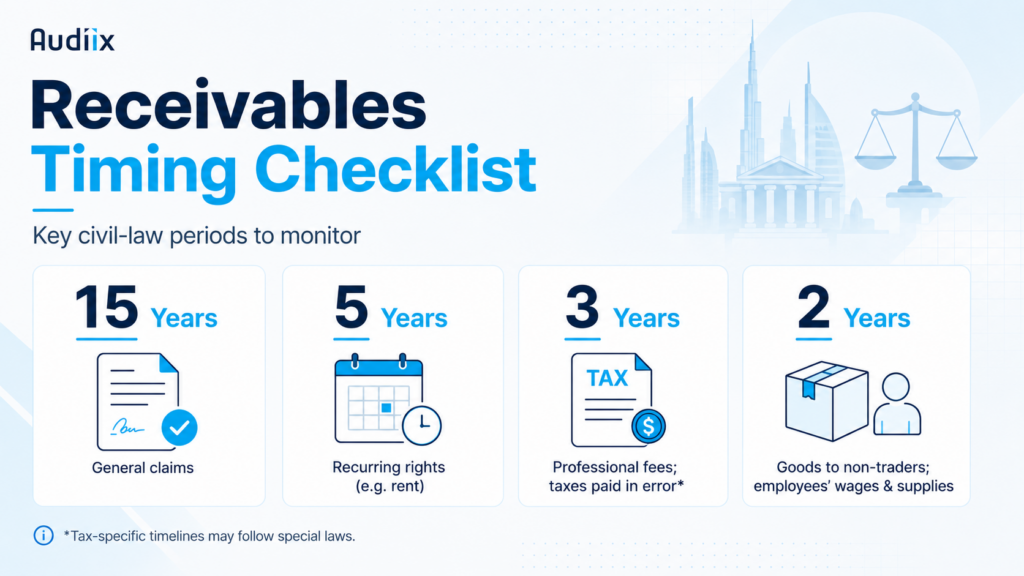
Key civil-law periods UAE businesses should monitor when reviewing receivables and supporting records.
Two practical points follow. First, for service firms and suppliers, an unpaid invoice does not remain litigation-safe forever, clean records, dated acknowledgements, and timely follow-up are what protect the right to recover. An express or implied acknowledgement of the debt by the customer restarts the clock (Article 439), which is exactly why disciplined bookkeeping and documented chasing matter. Second, the three-year reference to taxes is a general civil-law rule expressly stated to apply “without prejudice to special laws.” For FTA-administered taxes such as VAT and Corporate Tax, the Tax Procedures Law and its own time limits govern, so this is a point to confirm with your tax advisor, not a rule to apply on its own.
Hardship, unfair terms, and the limits on exercising your rights
The new law restates the court’s power to intervene where a contract becomes unbalanced. Under the hardship rule (Article 224), if exceptional, unforeseeable, general circumstances make performance so onerous that a party faces serious loss, the court may reduce the burdensome obligation to a reasonable level, and any agreement to the contrary is void. Separately, where a contract of adhesion (standard, non-negotiated terms) contains unfair conditions, the court may amend or set them aside (Article 223).
The “abuse of rights” doctrine is also refined (Article 106). Exercising a contractual or legal right becomes unlawful where the intent is to cause harm, where the benefit sought is unlawful or contrary to public order, where the benefit is disproportionate to the harm caused to others, or where it goes beyond accepted custom. In practice, this is a reminder that enforcing a clause aggressively, calling a default, withholding a deliverable, is not risk-free if it is plainly disproportionate.
Businesses should also be careful where financial distress, urgency, dependency, or commercial pressure is used to secure heavily one-sided terms, as this may raise separate legal issues around exploitation that should be reviewed by legal counsel.
A lower age of majority and modern contract formation
The age of majority falls to eighteen Gregorian years (Article 84), replacing the previous threshold of 21 lunar years under the former Civil Transactions Law. This affects who has full legal capacity to enter binding contracts, open accounts, and take on financial obligations, relevant to family businesses, young founders, and any onboarding or KYC process. Alongside this, the new law reflects how business is actually done today, recognising written communications, direct means of communication, conduct, and implied acceptance in contract formation, while clarifying that advertisements and price statements will generally be treated as invitations to contract where there is doubt.
What the 1 June 2026 transition means for existing contracts
The new law is not retroactive: as a rule, it does not reopen facts, acts, or contracts completed before it took effect. There is an important exception. Limitation periods that have not yet expired on 1 June 2026 fall under the new rules from that date, and where the new period is shorter, it is calculated from the effective date. Some mandatory provisions may also affect how ongoing relationships are interpreted or enforced, depending on the nature of the contract, the timing of the relevant facts, and any applicable special laws. Long-term agreements, framework contracts, and ongoing matters therefore deserve a fresh look rather than an assumption that “old contracts keep the old rules.”
The finance side of a legal change
A change to the Civil Code is, on paper, a legal matter, but much of its real-world impact lands in finance and operations. Limitation periods depend heavily on the quality of your records and how promptly receivables are managed. Disclosure duties depend on what your contracts, proposals, onboarding documents, and negotiation records actually capture. Hardship, pricing, and compensation clauses can connect directly to how revenue, obligations, provisions, and disputed balances are recognised in your books. Getting the legal wording right is your lawyer’s role; making sure your records, receivables, and reporting support those positions is where a disciplined accounting partner earns its place.
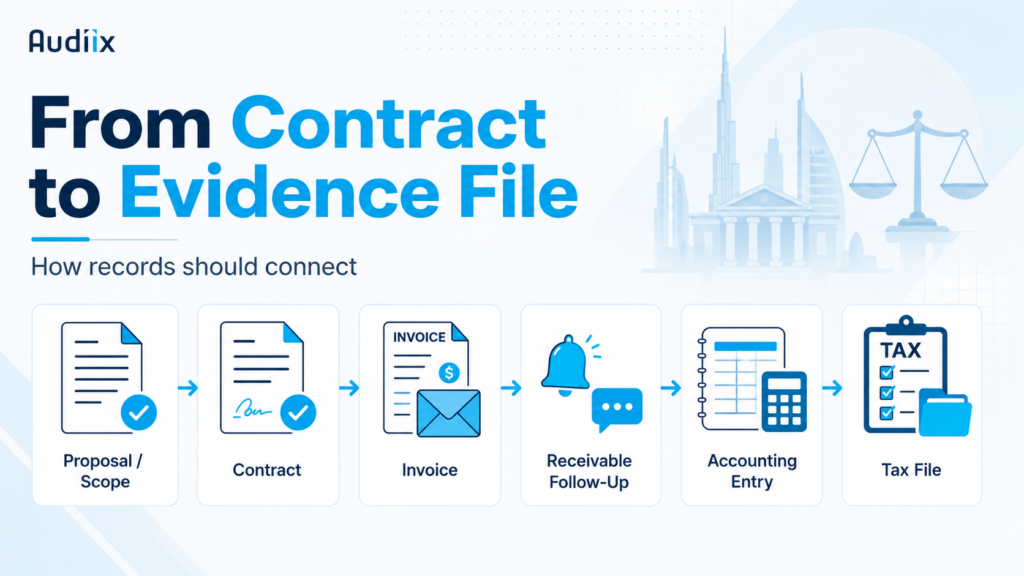
How contracts, invoices, receivables, accounting entries and tax files should connect under the UAE Civil Code 2026.
This also matters for confidential information, set-off, and intercompany balances. When businesses share management accounts, pricing models, tax information, customer data, forecasts, or due-diligence files during negotiations, they should keep a clear record of what was shared, with whom, and for what purpose. Where receivables and payables are netted off, assigned, settled, or written off, especially between related parties, the accounting entry should be supported by a clear commercial basis, approval trail, and tax-file explanation.
At Audiix, this is how we think about regulatory change: not as a one-off scramble, but as a reason to keep clean books, accurate records, and well-documented commercial dealings as a matter of routine, so that your numbers and paperwork support your business position when it matters.
What to review under the UAE Civil Code 2026
- Template and standard-form contracts, disclosure wording, termination rights, and any hardship or force-majeure clauses.
- Receivables and ageing, identify older balances against the relevant two-, three-, and five-year periods, and tighten how you document acknowledgements and follow-up.
- Long-term and framework agreements, check how the transition affects limitation periods and any clauses that may conflict with mandatory provisions.
- Onboarding and KYC, update for the new age of majority and the heightened disclosure expectations.
- Record-keeping discipline, ensure books, contracts, and supporting documents are complete, current, and audit-ready.
Recommended next steps
- Ask your legal counsel to review your contract templates and key agreements against the new law now that it is in force after 1 June 2026.
- Run a receivables review now, prioritise balances approaching the shorter limitation periods.
- Tighten the link between your contracts and your books so disclosures, pricing, and obligations are consistently recorded.
- Confirm tax-specific timelines (VAT, Corporate Tax) with your tax advisor rather than relying on the Civil Code’s general periods.
Clean books. On-time VAT and Corporate Tax. Decision-ready reports. If you would like a second pair of eyes on whether your receivables, contract records, and accounting files are clean enough to support your commercial position under the UAE Civil Code 2026, our team can review your position and coordinate with your legal advisors, as part of one integrated accounting, tax, and advisory relationship. Talk to Audiix about a review.