A correction that decreases Taxable Income is called a downward transfer pricing adjustment.
This guide explains the disclosure and documentation requirements for UAE downward transfer pricing adjustments under FTA Public Clarification CTP011.
What is this about?
When a UAE business deals with a parent company, subsidiary, shareholder, sister company, or another Related Party, the transaction must be priced as if the parties were independent. This is the arm’s-length principle, meaning the transaction is priced as independent businesses would have priced it.
Sometimes the amount recorded in the accounts does not reflect the price or profit that independent businesses would have agreed. The company must then correct the position in its UAE Corporate Tax Return. The correction may:
- increase Taxable Income (the income subject to Corporate Tax), resulting in more Corporate Tax; or
- decrease Taxable Income, potentially resulting in less Corporate Tax.
A correction that decreases Taxable Income is called a downward transfer pricing adjustment.
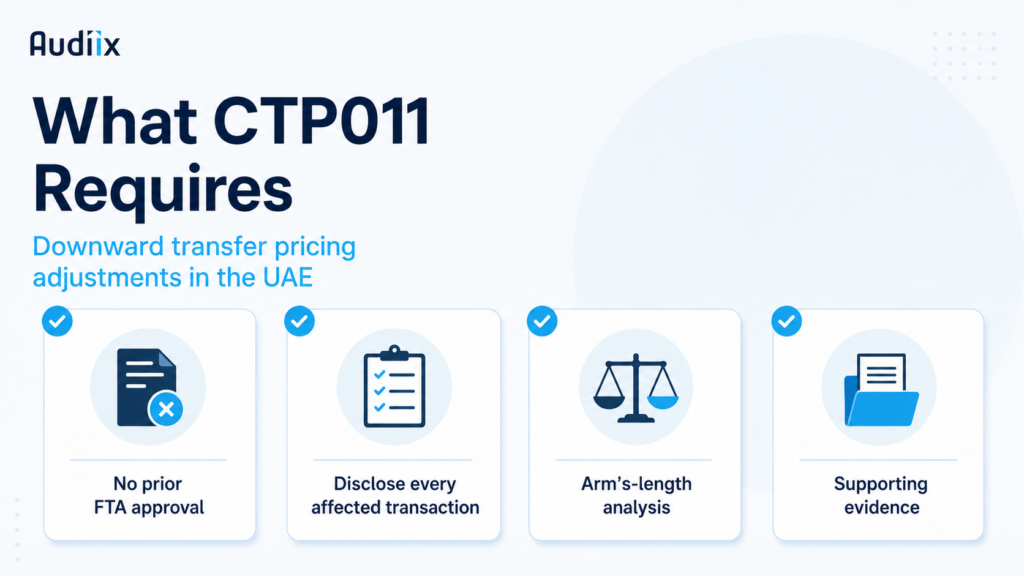
The Federal Tax Authority (FTA) has now issued Public Clarification CTP011 on downward transfer pricing adjustments (the FTA clarification). It confirms that a business does not need prior FTA approval to make this adjustment in its Corporate Tax Return. However, every affected transaction must be disclosed, and sufficient supporting analysis and documents must be maintained.
A reduction in Taxable Income does not necessarily produce an immediate tax saving. The actual effect depends on the company’s overall taxable position, applicable tax rate, Tax Losses, reliefs, and Free Zone status.
The better question is not whether you can make a downward adjustment. It is whether your accounts, benchmarking, and related-party records will hold up on the day the FTA opens a Tax Audit.
What CTP011 confirms about UAE downward transfer pricing adjustments
The FTA clarification is a Public Clarification, meaning it states the FTA’s position on how it interprets and administers existing requirements under the Corporate Tax Law. It does not amend the law. It confirms the following.
- No prior FTA approval. Corporate Tax is self-assessed. A business does not need prior approval from the FTA to make a transfer pricing adjustment in its Corporate Tax Return, whether the adjustment increases or decreases Taxable Income.
- Self-assessment, subject to later review. The business assesses whether the recorded values reflect an arm’s-length result and, where they do not, makes the adjustment in the Tax Return. Any adjustment may still be reviewed later through a Tax Audit and disallowed if the supporting position does not stand up.
- Broader disclosure for downward adjustments. Every Related Party transaction or arrangement affected by a downward adjustment must be disclosed in the Corporate Tax Return, regardless of its amount or nature. This is broader than the ordinary threshold-based Related Party disclosure requirement.
- Sufficient supporting documentation. The business should maintain sufficient supporting documents, including the rationale for the adjustment, an arm’s-length analysis with a benchmarking study (a study comparing the transaction or margin with independent market data), a reconciliation between the accounts and the Tax Return values, and evidence of a matching adjustment by the Related Party.
The clarification does not change the arm’s-length rule. It confirms the procedure for correcting a non-arm’s-length result in the Tax Return and sets out the FTA’s disclosure and documentation expectations. The adjustment remains subject to FTA review and is not automatically accepted merely because it is included in the return.
The clarification concerns an adjustment initiated by the UAE taxpayer in its own return. Separate statutory procedures may apply where an adjustment is made by the FTA, another UAE taxpayer, or a foreign tax authority.
A simple example
A UAE company charges its overseas parent AED 1.5 million for services. A transfer pricing study later supports an arm’s-length charge of AED 1.2 million.
If the AED 1.5 million remains recorded in the Financial Statements, the UAE company may make a AED 300,000 downward transfer pricing adjustment in its Corporate Tax Return. This reduces its Taxable Income by AED 300,000, subject to proper disclosure and supporting documentation.
The treatment of the AED 300,000 by the overseas parent must be considered separately under the applicable accounting rules and foreign tax law.
The AED 300,000 reduction in Taxable Income does not always produce a AED 27,000 saving in Corporate Tax. The actual effect depends on the company’s overall taxable position, applicable tax rate, Tax Losses, reliefs, and Free Zone status.
Evidence to retain for UAE downward transfer pricing adjustments
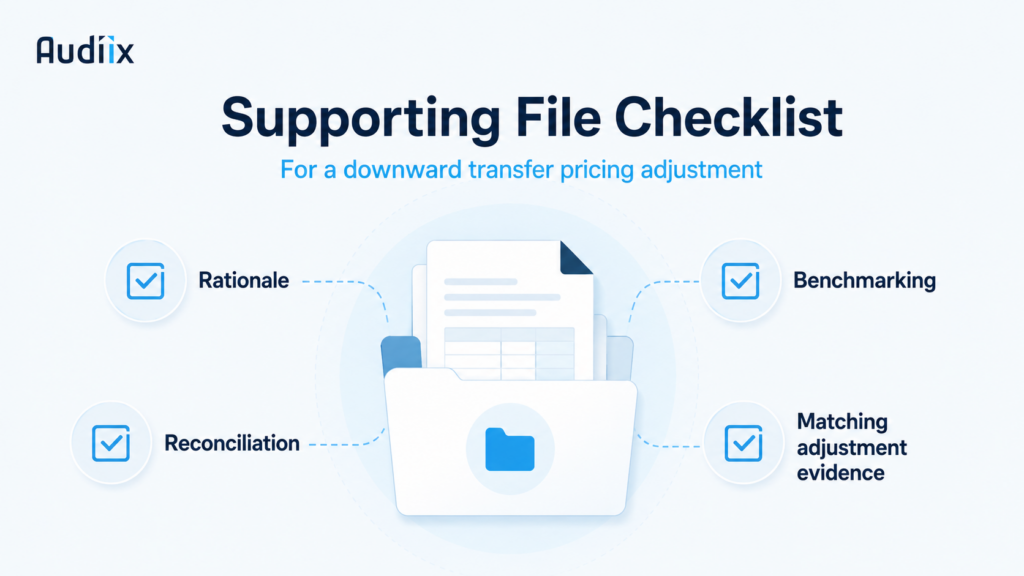
The FTA clarification says that a business making a downward adjustment should maintain sufficient supporting documents, including but not limited to:
- Rationale for the adjustment. Why the values originally recorded in the accounts did not reflect the arm’s-length principle, and how the revised outcome aligns with an arm’s-length result.
- Arm’s length analysis with benchmarking study. Evidence that the adjustment is consistent with the applicable transfer pricing methodologies and rules, supported by a study comparing the transaction or margin with independent market data.
- Between the values recorded in the Financial Statements and the arm’s-length values disclosed in the Tax Return.
- Matching adjustment by the Related Party. Evidence that the Related Party on the other side of the transaction has made a corresponding adjustment, so that the counterparty’s records reflect the matching side of the adjusted transaction.
In practical terms, the file for each downward adjustment should include at least the following, prepared and available by the time the Tax Return is filed wherever practicable:
- the related-party agreement and any relevant invoices, debit notes, or credit notes;
- transaction-level ledger records;
- the functional and benchmarking analysis;
- the calculation of the arm’s-length result and the selected point in any range;
- the reconciliation between the Financial Statements and the Tax Return; and
- counterparty confirmation and ledger evidence of the matching adjustment.
Important practical cautions
Financial Statements should ideally reflect arm’s-length pricing. The preferred position is for the accounts and underlying related-party entries to reflect the arm’s-length result in the first place. A Tax Return adjustment is a correction, not a substitute for pricing the transaction correctly.
The Tax Return adjustment is not the end of the process. A downward Corporate Tax adjustment does not, by itself, amend the underlying invoice, contractual consideration, or intercompany balance. The business should separately consider whether accounting entries, debit or credit notes, VAT treatment, customs values, withholding tax, and foreign tax filings need to be updated. This is particularly important where the Related Party sits abroad, because a UAE adjustment can trigger consequences in the counterparty’s jurisdiction that were not in scope when the original entries were booked.
The counterparty position must be considered. The matching adjustment expected of the Related Party is not automatic. Where the Related Party is in the UAE, the group should coordinate the counterparty’s books, so that the counterparty’s records reflect the matching side of the adjusted transaction. Where the Related Party is abroad, its treatment must be assessed under the applicable foreign law; a corresponding accounting adjustment does not automatically translate into an increase in foreign taxable income.
The most tax-favourable point in a range is not automatically supportable. Where the transfer pricing method produces an arm’s-length range, the selected result must be supported by the facts, functional analysis (analysis of what each party does, owns, and risks), and comparability evidence. A business should not automatically adjust to the most tax-favourable point in the range merely because that point reduces UAE Taxable Income.
What businesses should do now
- Review whether the transfer pricing policy is documented, applied consistently, and reflects the group’s current facts, functions, and risks.
- Complete or refresh the arm’s-length analysis and benchmarking before filing the Tax Return wherever possible. A study prepared only after the return may materially weaken the support for the adjustment.
- Align intercompany agreements, accounting policies, and invoicing so that downward adjustments in the Tax Return are the exception, not a recurring year-end correction.
- Build the four supporting elements (rationale, arm’s-length analysis with benchmarking, reconciliation, and matching-adjustment evidence) into a standing file for each downward adjustment.
- Where the Related Party sits abroad, coordinate with parent-jurisdiction advisors on the matching adjustment and any accounting, VAT, or foreign tax knock-on effects.
How Audiix helps
Audiix supports UAE businesses with Related Party transactions, including locally owned groups, family businesses, Free Zone companies, and foreign-owned subsidiaries. The Corporate Tax Return, Financial Statements, related-party ledgers, and transfer pricing documentation are prepared and reviewed by one team that already sees the numbers.
Where a downward transfer pricing adjustment may be required in your upcoming Corporate Tax Return, Audiix can review the pricing analysis, accounting records, reconciliation, and disclosure position before filing.
Frequently asked questions
Do UAE downward transfer pricing adjustments require prior FTA approval?
No. Corporate Tax is self-assessed. A business does not need prior FTA approval to make a transfer pricing adjustment in its Corporate Tax Return, whether the adjustment increases or decreases Taxable Income. The adjustment may still be reviewed later through a Tax Audit.
Must every affected transaction be disclosed?
Yes, for downward adjustments. Every Related Party transaction or arrangement affected by a downward adjustment must be disclosed in the Corporate Tax Return, regardless of its amount or nature. The ordinary threshold-based disclosure logic applies to routine Related Party reporting, not to downward adjustments.
What documents should be retained?
Sufficient supporting documents, including the rationale for the adjustment, an arm’s-length analysis with a benchmarking study, a reconciliation between the Financial Statements and the Tax Return, and evidence of a matching adjustment by the Related Party. The complete supporting file does not have to be uploaded with the Tax Return. As a practical and audit-defensible approach, it should be prepared and available by the filing date wherever practicable and produced to the FTA if requested.