
What changed, when each change takes effect, and what UAE businesses should review across Input Tax recovery, employee benefits, payment records and the Capital Asset Scheme.
The UAE VAT changes from October 2026 amend the Executive Regulation of its VAT legislation. Cabinet Decision No. 149 of 2026 was issued on 1 September 2026 and announced by the Ministry of Finance on 8 September 2026. It replaces nine existing provisions and adds three new ones, and it takes effect on 1 October 2026. One part is deferred: the rewritten Input Tax apportionment rules in Article 55 apply only from the first Tax year commencing after 1 October 2027.
The amendments reach composite supplies, the profit margin scheme, zero-rated healthcare goods, the “outside the State” test, employee benefits and accommodation, cash payments, Input Tax apportionment, the Capital Asset Scheme and tax credit notes. Most of the commercial impact falls on one question: how much Input Tax a business may recover, and what it must be able to show in support. Three changes carry the broadest reach, and one, the move to a value of supplies apportionment method, is the most consequential for businesses making exempt supplies.
The practical starting point is not the analysis but the tracking. These changes have to be picked up and applied by whoever prepares the VAT returns, in-house or outsourced, and the first job is to establish precisely what changed and from which date. Cabinet Decision No. 149 of 2026 is the seventh Cabinet Decision to amend the Executive Regulation since it was issued in 2017, following amendments in 2020, twice in 2021, and in 2022, 2024 and 2025. Each carries its own effective date, and this one carries two. Keeping an accurate record of which version of a clause applies, and from when, is now part of the VAT compliance file rather than a technical footnote.
From 1 October 2026, can your records explain why you recovered the Input Tax you recovered?
What changed, and when
The instrument amended is Cabinet Decision No. 52 of 2017, the Executive Regulation of Federal Decree-Law No. 8 of 2017 on Value Added Tax. Cabinet Decision No. 149 of 2026 is an amending instrument, not a repeal: Article 1 replaces the nine provisions, Article 2 adds the three new clauses, and everything else in the Executive Regulation continues to apply as before. Article 3 carries the two effective dates, holding Clauses 6, 7 and 19 of Article 55 back to the first Tax year commencing after 1 October 2027.
| Article / clause | Amendment or addition | Audiix comment and analysis |
| Article 4(6) Supply of more than one component [New] |
A Taxable Person may not treat a supply consisting of more than one component as multiple supplies where the nature and economic substance of the supply demonstrate that the components are interconnected and cannot be separated. In that case, the transaction is treated as a single composite supply and follows the VAT treatment of its principal component. | The amendment strengthens the economic substance approach to composite supplies. Separate contractual descriptions, prices or invoice lines do not necessarily establish separate supplies if the components are economically inseparable. The analysis should focus on what the customer is substantively receiving. |
| Article 29(5) Profit Margin Scheme [Amended] |
Costs or fees incurred to purchase eligible Goods are included in the “purchase price” only where the Input Tax on those costs or fees, where incurred, is not recoverable under Article 54 of the VAT Law. | Prevents a double VAT benefit. A business should not both recover the VAT on an acquisition-related cost and also use that same cost to reduce the taxable profit margin. |
| Article 41(4) Zero-rating Healthcare Services [Amended] |
The previous separate references to pharmaceutical products and medical equipment are replaced with “medical product”, as specified in a Cabinet Decision. Other Goods supplied in the course of providing zero-rated Healthcare Services remain zero-rated where necessary for those services. | Mainly a terminology and legislative alignment change. It should not be read as automatically zero-rating all medical or healthcare-related Goods. The relevant Cabinet Decision determines which medical products qualify. |
| Article 52(2) Input Tax Recovery in Respect of Exempt Supplies [Amended] |
A Person is treated as “outside the State” for Article 52 purposes where present in the UAE for less than 30 days and that presence is not effectively connected with the relevant supply. | Replaces the less precise expression “less than a month” with a specific day count. “Less than 30 days” means up to 29 days. This test relates specifically to Article 52 and certain financial services Input Tax recovery. It is not a general test for all exported services. |
| Article 53(1)(c)(1) Employee benefits, labour law obligation [Amended] |
Input Tax on Goods or Services provided free to employees for their personal benefit may remain recoverable where their provision is mandatory under applicable labour legislation in the UAE or any financial or non-financial free zone. Employer-provided accommodation is excluded unless it is mandatory pursuant to decisions or directives issued by MoHRE. | The amendment expressly broadens the wording from the previous “Designated Zone” reference to financial and non-financial free zones. At the same time, it introduces a specific restriction for employee accommodation. A general contractual or operational requirement does not satisfy this particular exception. |
| Article 53(1)(c)(2) Employee benefits, contractual obligation or documented policy [Amended] |
The previous requirement that the benefit enable employees to perform their role and represent normal business practice is removed. Recovery now applies where provision is a contractual obligation or documented policy, subject to the cases and conditions specified by the FTA. | A contract or HR policy alone should not automatically be treated as sufficient. The entitlement is expressly dependent on FTA-prescribed cases and conditions. Until those are identified, this area should be treated conservatively. |
| Article 54(3) Cash payments [New] |
Input Tax may not be recovered on a supply whose value exceeds an amount specified in a Ministerial Decision where the consideration is paid or intended to be paid in cash, subject to the controls specified in that decision. | Creates a new payment method restriction on Input Tax recovery. This may result in blocking Input VAT recovery for high-value supplies settled in cash. Businesses should review their cash purchase and expense arrangements. |
| Article 55(6) Input Tax apportionment [Amended] |
Direct attribution continues: Input Tax relating wholly to qualifying supplies may be recovered, non-recoverable Input Tax remains blocked, and mixed Input Tax is apportioned. A separate mechanism is introduced for Government Entities and Charities through Article 55(19). | The fundamental distinction between wholly recoverable, wholly non-recoverable and residual Input Tax remains. The major change lies in how residual Input Tax is apportioned under Clause 7. |
| Article 55(7) Standard Input Tax apportionment method [Amended] |
The standard recovery percentage changes to an output or value of supplies method: qualifying supplies under VAT Law Article 54(1) divided by the total value of all supplies. Supplies of Capital Assets and receipts of Concerned Goods and Concerned Services under Article 48 are excluded. The percentage is rounded to the nearest whole number and applied to residual Input Tax. | This replaces the existing Input Tax based standard method with a turnover or output based method. Direct attribution remains unchanged and the new percentage applies to residual or shared Input Tax. Depending on the business model, recoverable VAT may increase or decrease materially. |
| Article 55(19) Government Entities and Charities [New] |
Government Entities and Charities use a separate method based on recoverable Input Tax under VAT Law Articles 54(1) and 57 divided by total recoverable and non-recoverable Input Tax. The percentage is rounded to the nearest whole number and applied to the relevant residual Input Tax. | Government Entities and Charities do not move to the general output based method. Their method remains substantially Input Tax based because of the special recovery rules applicable to them. |
| Article 57(1) Assets considered Capital Assets [Amended] |
A Capital Asset is now defined as a business asset with a cost of AED 5,000,000 or more, excluding VAT, on which VAT is payable, with the prescribed useful life. The provision also expressly refers to the Capital Asset Scheme under VAT Law Articles 12 and 60. | The amendment shifts the wording from a “single item of expenditure” to the underlying business asset and its cost. The AED 5 million threshold remains unchanged, as do the minimum useful lives of 10 years for buildings and 5 years for other Capital Assets. |
| Article 60(1)(a) Tax Credit Notes [Amended] |
The words “Tax Credit Note” must be clearly displayed on the credit note. The previous wording referred incorrectly to displaying them “on the invoice”. | Drafting correction only. No substantive change to the VAT treatment or the other required contents of a Tax Credit Note. |
Table 1: Provision-by-provision summary of Cabinet Decision No. 149 of 2026. The third column is Audiix commentary and interpretation, not legislative text.
Three changes with potentially broad business impact
1. Bundled offers now face an economic substance test
Article 4 already contains a substantive test for determining whether multiple components form a single composite supply, including whether the elements are so closely linked that splitting them would be impossible or unnatural, alongside the conditions on separate pricing and a single supplier. New Article 4(6) strengthens this by adding an express economic substance rule: where the nature and economic substance of the supply show that the components are interconnected and cannot be separated, they cannot be treated as multiple supplies. In that case the supply is deemed a single composite supply and follows the tax treatment of its principal component.
This matters most where components would otherwise attract different treatment, for example a standard-rated element packaged alongside a zero-rated or exempt one. Splitting out a price line may no longer be enough on its own. If you sell software with mandatory implementation and support, a training programme with materials, or a service contract with an equipment element, the commercial reason for treating the components separately should be documented rather than assumed.
2. Employee benefits and staff accommodation
Article 53 blocks Input Tax on goods and services provided to employees free of charge for their personal benefit, subject to exceptions. Two of those exceptions have been rewritten.
The labour law exception previously referred to a labour law applicable in the State or a Designated Zone. It now refers to labour legislation in the State or any free zone, including financial and non-financial free zones. At the same time, the amendment carves out accommodation provided by an employer to its employees, unless that accommodation is mandatory pursuant to decisions or directives issued by the Ministry of Human Resources and Emiratisation.
The practical effect depends on whether Input Tax arises at all. Where the accommodation is a lease of a residential building that meets the conditions in Article 43 of the Executive Regulation, the supply is exempt, so no Input Tax arises on the rent itself and there is nothing to block. The recovery issue therefore arises where the accommodation supply itself is taxable, such as qualifying serviced accommodation, or where separate taxable costs are incurred in connection with the accommodation. These costs should be assessed individually. FTA Public Clarification VATP003 remains relevant to determining whether accommodation is residential or serviced.
The second exception, for a contractual obligation or documented policy, has changed character. The previous wording set its own test: the benefit had to enable employees to perform their role and be provable as normal business practice. The new wording instead defers to the cases and conditions specified by the FTA. From 1 October 2026, an employment contract or documented HR policy is not, by itself, sufficient to establish recovery under this exception: the benefit must also fall within those specified cases and conditions. At the date of publication, we have not identified published FTA criteria implementing the amended provision. Accordingly, recovery relying on Article 53(1)(c)(2) should be confirmed against any FTA criteria in force at the relevant time.
The specific accommodation exclusion is contained in Article 53(1)(c)(1). Whether employer-provided accommodation could qualify separately under Article 53(1)(c)(2) will depend on the cases and conditions specified by the FTA and should not be assumed.
3. Cash payments may cost you the Input Tax
New Article 54(3) provides that Input Tax may not be recovered on any supply with a value exceeding an amount to be specified in a decision issued by the Minister of Finance, where the consideration is paid or intended to be paid in cash, in accordance with the controls set out in that decision. Once the implementing Ministerial Decision applies, the method of settlement will become an additional Input Tax recovery condition for supplies falling within the prescribed value threshold and controls.
The threshold and the controls had not been issued at the date of publication, so the rule cannot yet be applied to a specific amount. As a practical risk management measure, businesses may wish to identify material cash purchases now and consider using traceable non-cash payment methods pending publication of the threshold and detailed controls. This is a preparatory recommendation rather than a separate statutory banking channel requirement. Your accounts payable data should also be able to identify the payment method for each supply. Separately, FTA Decision No. 13 of 2026, issued on 22 July 2026 and effective from 1 October 2026, introduces verification measures and conditions for supplies before deduction of Input Tax for the purposes of Article 54 bis of the VAT Law. This is a separate regime from Cabinet Decision No. 149 of 2026 and should not be conflated with the new cash payment restriction.
If you make exempt supplies, the apportionment change is the one to model
This is the most consequential amendment in the package, and it is also the one with the longest runway. The standard method for apportioning residual Input Tax moves from a calculation based on Input Tax to one based on the value of supplies.
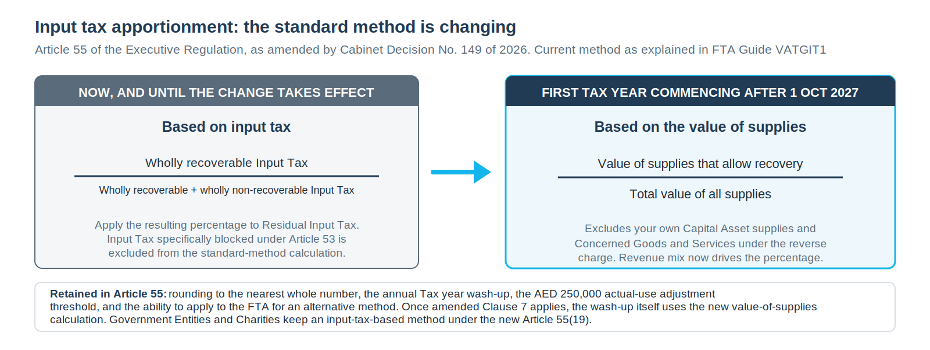
Figure 1: The standard apportionment method before and after the change. The current method is as set out in Article 55 and explained in the FTA Input Tax Apportionment Guide (VATGIT1).
The two methods can produce very different answers. Consider a VAT-registered business that earns taxable consulting revenue and exempt residential rental income. Under the current Input Tax basis, the rental activity may absorb relatively little Input Tax, so the recovery percentage stays high. Under a value of supplies basis, the rental revenue enters the denominator directly and can pull the percentage down, even though the cost base has not moved. Businesses making a material mix of supplies that permit Input Tax recovery and exempt supplies, particularly financial services, insurance and mixed-use real estate businesses, are likely to be the most affected.
Two points are worth holding on to. First, the annual Tax year wash-up requirement, the rounding requirement and the AED 250,000 actual-use adjustment threshold remain in Article 55. However, once the amended Clause 7 becomes effective, the annual wash-up will itself use the revised value of supplies methodology. Second, the ability to apply to the FTA for an alternative apportionment method remains available under Article 55, and approval is not automatic, so any application needs to be prepared and submitted well before the new method applies. For a taxable person whose VAT Tax year ends 31 December, the first affected Tax year begins on 1 January 2028. Check the Tax Period recorded on your VAT registration certificate rather than assuming it follows your financial year.
The clarifying changes, and why one of them still costs money
Four of the remaining amendments are mainly clarificatory or drafting changes, and Table 1 sets each of them out. One is worth a word of explanation: replacing “less than a month” in Article 52(2) with a fixed period of less than 30 days removes the ambiguity of a calendar month that can run from 28 to 31 days.
Article 29(5), by contrast, can directly change the margin on which VAT is calculated. Purchase costs and fees may now be added to the margin scheme purchase price only where the Input Tax on them is not recoverable. Where that Input Tax is recoverable, the cost leaves the margin base, the margin widens, and the VAT due on the sale increases. The illustration below assumes the Input Tax on the fees is recoverable.
| Illustration: second-hand goods dealer | Until 30 Sep 2026 | From 1 Oct 2026 |
| Purchase from a non-registrant | AED 100,000 | AED 100,000 |
| Transport and inspection fees, Input Tax AED 250 recoverable | AED 5,000 included | Excluded |
| Purchase price for margin purposes | AED 105,000 | AED 100,000 |
| Selling price | AED 126,000 | AED 126,000 |
| Profit margin, inclusive of Tax | AED 21,000 | AED 26,000 |
| VAT due on the margin at 5/105 | AED 1,000 | AED 1,238 |
Table 2: Illustrative only. The outcome depends on whether the Input Tax on the acquisition costs is in fact recoverable in your circumstances.
For dealers in second-hand goods, antiques and collectors’ items, the consequence is a record-keeping one. The margin scheme working papers or supporting stock records should distinguish acquisition costs on which Input Tax was recoverable from those on which it was not, so that the Article 29(5) purchase price calculation can be substantiated.
What this means for your books and records
Almost every change in this Decision is answered by a record rather than by a return. The VAT return will look the same. What changes is the evidence sitting behind each figure.
- Payment method becomes a tax attribute. Your purchase ledger should capture how each supply was settled, not only when.
- HR documentation becomes tax documentation. Employment contracts, benefit policies and accommodation arrangements now sit inside the Input Tax recovery analysis.
- Revenue analysis by VAT treatment becomes load-bearing. The coming apportionment method runs off the value of supplies, so revenue coding should be clean well before the first affected Tax year.
- The fixed asset register carries more weight. The revised definition focuses on the business asset and its cost, so the fixed asset register should be reconciled to the underlying expenditure and Capital Asset Scheme records.
- Pricing and invoicing choices become positions. Where you split a bundle into separately priced components, the file should record why those components are genuinely separable.
What to review now
- Bundled products and services. List every offer sold as separate components and document the commercial reason each component stands alone.
- Employee benefits and accommodation. Map each benefit to its basis for recovery, separating what is mandatory under labour legislation from what rests on a contract or policy, and identify which accommodation costs actually carry Input Tax.
- Cash purchases. Quantify supplies settled in cash by value, and consider setting an internal ceiling for cash settlement pending the Ministerial Decision.
- Partial exemption. If you make exempt supplies, model the value of supplies method alongside your current calculation across a full Tax year, and improve direct attribution so that Residual Input Tax is limited to costs that are genuinely mixed.
- Margin scheme records. Ensure the margin scheme working papers or supporting stock records distinguish acquisition costs whose Input Tax was recoverable from those whose Input Tax was not.
- Templates and masters. Check the credit note template, the product tax codes for medical products, and the fixed asset register against the amended definitions.
What is not settled yet
Two implementation items remain outstanding, while one further area requires confirmation of the Cabinet Decision or Decisions in force:
- The value threshold and controls for the cash payment restriction, which sit with the Minister of Finance under Article 54(3).
- The cases and conditions for the contractual obligation or documented policy exception for employee benefits, which sit with the FTA under Article 53(1)(c)(2).
- The scope of “medical products” under Article 41(4)(a) should be checked against the Cabinet Decision or Decisions in force. Cabinet Decision No. 56 of 2017 already provides zero-rating for qualifying medications and medical equipment registered with the Ministry of Health and Prevention, or imported with its permission or approval. Businesses should monitor whether a new or amended Cabinet Decision is issued to align that framework with the revised “medical product” terminology before changing product tax codes.
Common questions
When does Cabinet Decision No. 149 of 2026 take effect?
From 1 October 2026, with one exception. Clauses 6, 7 and 19 of Article 55, which govern Input Tax apportionment, apply from the first Tax year commencing after 1 October 2027.
Does this change the VAT rate or the registration thresholds?
No. This Decision does not amend the 5% standard rate, the mandatory registration threshold of AED 375,000, or the voluntary registration threshold of AED 187,500. It changes the treatment or classification of certain supplies and a number of Input Tax recovery and apportionment rules.
Can we still recover Input Tax on staff accommodation?
It depends on the arrangement. Accommodation is now excluded from the labour legislation exception in Article 53(1)(c)(1) unless its provision is mandatory pursuant to decisions or directives issued by MoHRE. Where the accommodation is a lease of a residential building that meets the conditions in Article 43 of the Executive Regulation, no VAT arises on the exempt rent itself. Separate taxable costs connected with the accommodation, such as certain utilities, management, fit-out or other services, must be analysed separately under the normal Input Tax recovery rules and Article 53.
Do we need to act on the cash payment rule now?
The restriction in Article 54(3) applies from 1 October 2026, but it operates by reference to a value and controls to be specified by the Minister of Finance, which had not been issued at the date of publication. As a prudent preparatory measure, identify high-value cash settlements now and consider moving them to traceable non-cash payment methods pending publication of the Ministerial Decision.
How Audiix helps
Most of this update is accounting work wearing a tax label. Where a position requires formal representation before the FTA, it should be handled through a registered Tax Agent, and legal issues may require legal counsel. Audiix can support the VAT analysis, compliance controls, documentation and, where appointed, Tax Agent representation. This includes reviewing whether the purchase ledger identifies payment method, whether the HR file supports the benefit recovery position, whether revenue is coded cleanly enough for the value of supplies apportionment before the first affected Tax year, and whether the fixed asset register matches the amended Capital Asset definition.
Because bookkeeping, VAT and Corporate Tax sit with one coordinated team at Audiix, these checks happen in the same place as the books rather than as a separate exercise months later.
A focused VAT health check is the practical starting point. If you would like a second pair of eyes on whether your records, payment data and employee benefit documentation will support your Input Tax position from 1 October 2026, Audiix can review the files and build the changes into your monthly accounting and compliance plan.