Specialist Corporate Tax, Transfer Pricing, and Group Structuring guidance for family-owned groups, founders with holding structures, family offices, foundations and trusts, and cross-border wealth structures.
Quick answer
- The Federal Tax Authority (FTA) released an updated Corporate Tax Guide on the Taxation of Family Foundations (reference CTGFF1) in June 2026, replacing the first version from May 2025. The Article 17 Family Foundation framework itself has not changed. What has changed is the FTA’s guidance, including new explanations on family offices, transfers into Family Foundations, companies moving into or out of structures, and related Free Zone references.
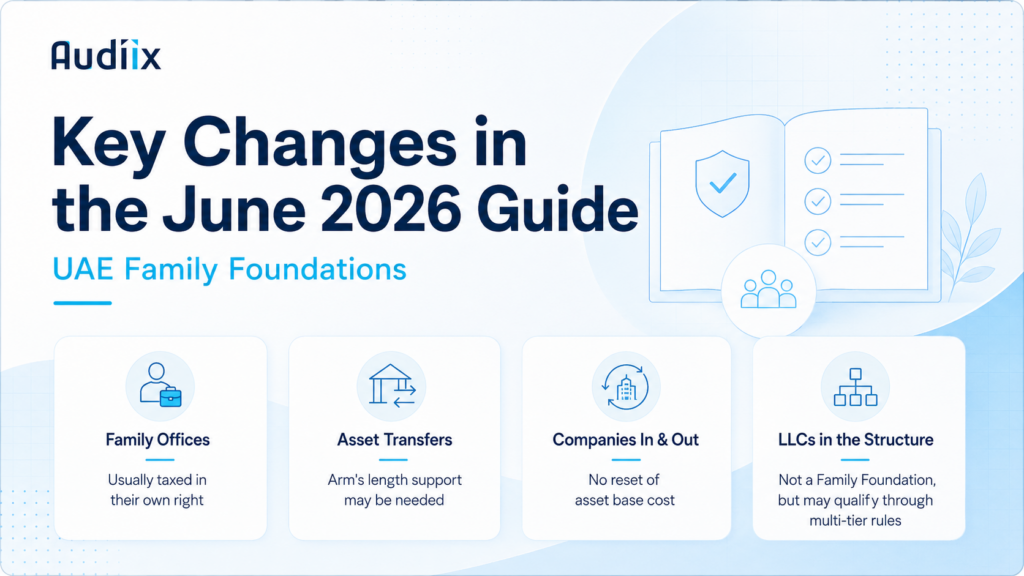
- The headline addition is clearer treatment of family offices: a Single or Multi Family Office is generally unlikely to qualify for tax-transparent treatment and is normally subject to Corporate Tax on its income, including management fees.
- New guidance also covers transfers of assets into a Family Foundation (arm’s length where a Related Party is involved) and what happens to a company’s tax status and asset base cost when it enters or leaves the structure.
- The guide confirms that an LLC is not a “similar entity” to a foundation or trust, so it cannot apply as a Family Foundation in its own right. However, an LLC that is wholly owned and controlled by a Family Foundation may still be eligible to apply for fiscally transparent treatment under the multi-tier structure rules, if the relevant conditions are met and the required application is approved.
- If you hold family wealth through a UAE foundation, trust, or holding company, this is the moment to review your structure, your transparency applications, and your related-party documentation.
Families often set up a foundation or trust to keep wealth organised and protected, and may assume the tax treatment follows automatically. From a UAE Family Foundation Corporate Tax perspective, the better question is whether the structure on paper matches the records, elections, and pricing behind it. The FTA’s updated guide is a useful reminder that passive holding and active management are taxed differently, and that the line between them is drawn by how a structure is documented and run, not by intention.
In June 2026 the FTA published an updated version of its Corporate Tax Guide on the Taxation of Family Foundations (CTGFF1), replacing the first edition from May 2025. The legal framework itself has not moved: Article 17 of the Corporate Tax Law (Federal Decree-Law No. 47 of 2022) still governs when a Family Foundation can apply to be treated as fiscally transparent, meaning taxed in the hands of its beneficiaries rather than in its own right, provided the conditions are met and the FTA approves the application. What changed is the guidance around it, and some of it has a real commercial edge.
Does your family structure actually qualify for the tax treatment you are relying on, and can your records prove it?
UAE Family Foundation Corporate Tax: What changed in the June 2026 guide
According to the guide’s own update log, the FTA refreshed the legislative references (Section 2.5), the description of trusts and “similar entities” (Sections 3.3 and 3.4), the multi-tier structure examples (Section 6), and added three new areas to Section 7: transfers into a Family Foundation (7.8), companies acquired or sold by a Family Foundation (7.9), and family offices (7.10). The most commercially significant of these is the family office guidance, which brings the guide into line with the FTA’s Public Clarification on the Corporate Tax treatment of family wealth and management structures (CTP008), as referenced in the guide.
Family offices are generally taxable, not transparent
A Single Family Office (SFO) or Multi Family Office (MFO) can be a company that is wholly owned and controlled by a Family Foundation. But because of what it actually does, managing assets and charging fees, it is unlikely to meet all the conditions in Article 17(1), in particular the condition that it does not conduct a Business or Business Activity that would be subject to Corporate Tax. The FTA’s position in the guide is therefore that an SFO or MFO, as a UAE resident, is subject to Corporate Tax on all of its income, including management fees and any other income it receives. Because it deals with the family’s own entities, it must also be remunerated at arm’s length for services provided to Related Parties and Connected Persons.
There is a Free Zone route, but with a condition that matters. Where the family office is a Free Zone Person, it may access the 0% Corporate Tax rate on Qualifying Income from Qualifying Activities, such as wealth and investment management or fund management, but only where those activities are subject to the regulatory oversight of a competent UAE authority. The guide names the UAE Central Bank, the Dubai Financial Services Authority (DFSA) in the DIFC, and the Financial Services Regulatory Authority (FSRA) in the ADGM. A family office that merely holds a licence, without that regulatory oversight, does not get Qualifying Activity treatment for those services. In plain terms, the 0% rate is earned by being properly regulated, not simply by sitting in a free zone.
Putting assets in, and moving companies in and out
New Section 7.8 addresses how assets are contributed to a foundation. When a founder or settlor funds the structure, the transfer can carry a Corporate Tax consequence. Where the person making the transfer is a Related Party to the foundation, the transaction should meet the arm’s length standard, and any gain or loss can fall within Corporate Tax depending on the facts, including whether the transferor is itself a taxable person. There is an important carve-out: where the transferor is a natural person and the assets are personal investments or real estate investments, the transfer is not subject to Corporate Tax.
New Section 7.9 deals with companies that move into or out of a Family Foundation. A company that becomes wholly owned and controlled by a Family Foundation does not automatically stop being taxed in its own right: it may become fiscally transparent only where the conditions are met, the required application is made, and the FTA approves it. A company that later leaves the structure, or fails to keep meeting the conditions, can revert to being an ordinary taxable company. The point worth flagging is that the FTA confirms there is no reset of the base cost of the company’s assets when its status changes. The periods of transparency are ignored for base cost purposes, which becomes relevant when those assets are eventually sold and a gain is calculated.
“Similar entity” does not mean any company
The update also tightens a point that has caused confusion. A limited liability company (LLC) is not a “similar entity” to a foundation or trust, so an LLC cannot apply as a Family Foundation in its own right. However, an LLC that is wholly owned and controlled by a Family Foundation may still be eligible to apply for fiscally transparent treatment under the multi-tier structure rules, provided the relevant conditions are met and the required application is made. The distinction matters: the entry point for transparency is the foundation or trust at the top, while companies underneath it qualify through the wholly owned and controlled route, not as Family Foundations themselves.
Why this matters for your records and tax files
For founders and family groups, the practical message is consistent. The tax outcome of a family structure now depends heavily on evidence: that the foundation or trust genuinely meets the Article 17 conditions, that transfers in were priced and documented at arm’s length, that any family office charges market-rate fees under proper agreements, and that base cost and ownership history are tracked through every change in the structure. None of that lives in the foundation deed. It lives in the bookkeeping, the transfer pricing file, the intercompany agreements, and the Corporate Tax registrations and elections. A clean structure on paper with thin records behind it is exactly the position the guide is nudging families away from.
What to review now
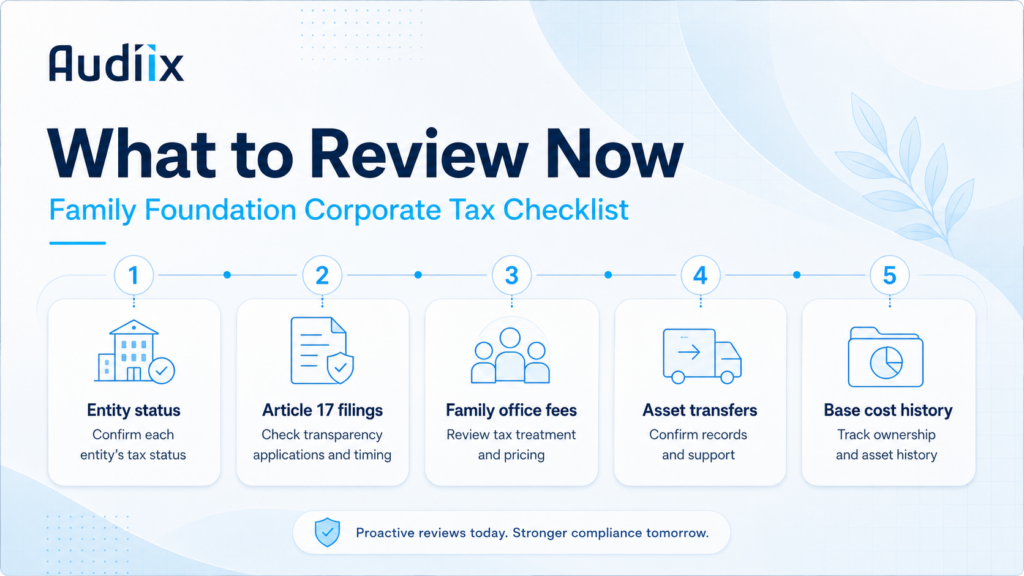
- Confirm the status of each entity in your structure: Family Foundation, transparent Unincorporated Partnership, or ordinary taxable company, and whether the right Article 17 application was filed and on time.
- For each relevant entity, check the compliance chain that transparency depends on: Corporate Tax registration, the transparency application, the Tax Period selected in that application, and the annual confirmation that the conditions continue to be met. Transparency is not a one-off election; it relies on ongoing compliance.
- Identify any family office (SFO or MFO) in the group and confirm how its income, especially management fees, is being taxed, and whether any Free Zone 0% claim rests on genuine regulatory oversight.
- Check that fees and recharges between the family office and family entities are set and documented at arm’s length, supported by agreements and a transfer pricing basis.
- Review how assets were transferred into the structure, and whether the treatment, taxable or carved-out, was supported by records at the time.
- Make sure base cost and ownership history are documented for any company that has moved into or out of the structure.
Recommended next steps
- Map the structure on one page: each entity, its Corporate Tax status, and the election or filing that supports it.
- Separate the legal and financial review: your private-client lawyer or structuring advisor confirms the deeds and licensing; your accountants confirm the registrations, elections, pricing, and records.
- Prioritise the family office, as it is the entity most likely to carry an unbudgeted Corporate Tax cost.
- Build or refresh a transfer pricing and intercompany file before the next return, not during it.
- Where anything is unconfirmed, document the assumption and its basis now, while the facts are fresh.
Common questions
Is a UAE family office tax-free?
Generally no. A Single or Multi Family Office is usually subject to Corporate Tax on its income, including management fees, because it is unlikely to meet all the Article 17 conditions for transparency. A Free Zone family office may reach 0% on qualifying income only where its activities carry genuine regulatory oversight from a competent UAE authority.
Can a foundation hold a family office and still be tax transparent?
The foundation itself can remain transparent if it meets the Article 17 conditions, but the family office it owns is generally taxed in its own right. Transparency at the top does not make the operating family office tax-free.
Can an LLC be treated as a Family Foundation?
No. An LLC is not a “similar entity” to a foundation or trust, so it cannot apply as a Family Foundation in its own right. However, an LLC that is wholly owned and controlled by a Family Foundation may still be eligible to apply for fiscally transparent treatment under the multi-tier structure rules, provided the relevant conditions are met and the required application is made.
What should families review after the June 2026 Family Foundations guide?
Families should review their Corporate Tax registration, Article 17 transparency applications, family office fee arrangements, transfer pricing documentation, and asset base-cost records.
How Audiix helps
Legal counsel owns the foundation and trust deeds, enforceability, and licensing. For UAE Family Foundation Corporate Tax files, Audiix supports the financial and tax side: Corporate Tax registration and transparency applications, arm’s length documentation for family office fees and asset transfers, base-cost and ownership records, and decision-ready reporting for the family. If you would like a second pair of eyes on whether your structure’s records, elections, and related-party pricing support the tax treatment you are relying on, Audiix can review the numbers and tax files and coordinate with your legal and structuring advisors. This work often starts as a focused Corporate Tax health check and continues through our Transfer Pricing and Group Structuring support and monthly compliance plans.