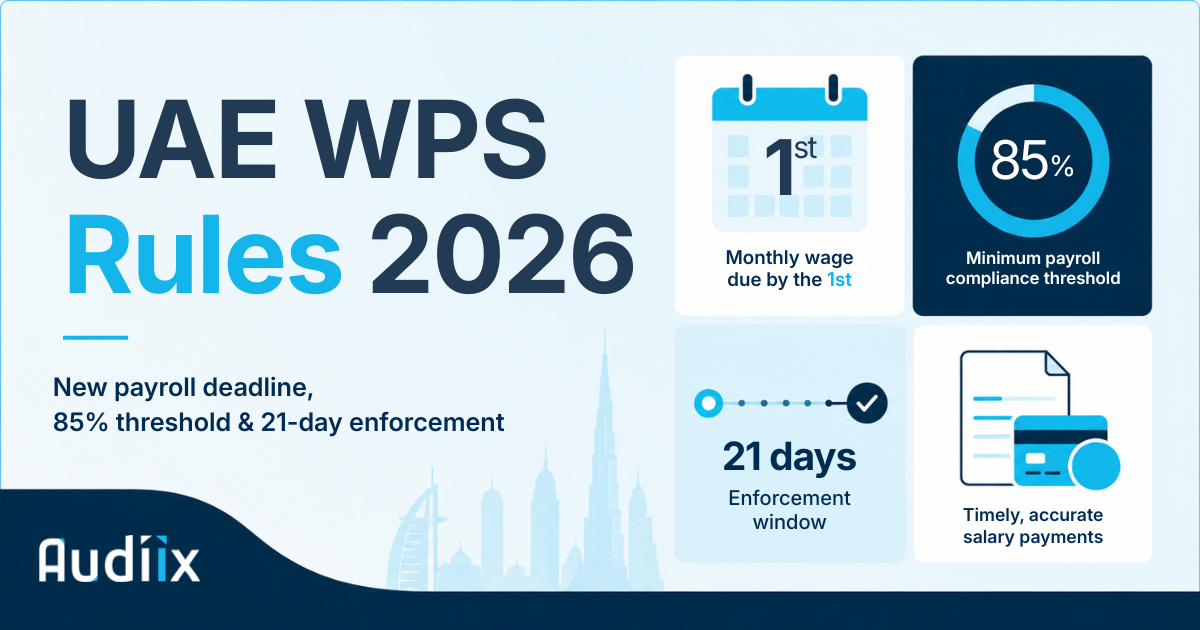
UAE WPS rules 2026 introduce a stricter payroll compliance framework for UAE private sector employers. From 1 June 2026, businesses must prepare for 1st-day salary payments, an 85% WPS compliance threshold, faster enforcement action, and clearer payroll delegation rules.
UAE WPS Rules 2026: Key Highlights
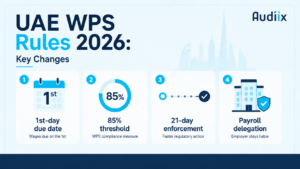
1. Unified Wage Due Date: The 1st Day of Each Gregorian Month
From 1 June 2026, all wages must be paid by the first day of each Gregorian month. Any payment after that date is treated as delayed wage payment.
Why it matters: The 2022 framework allowed a 15-day late-payment threshold. The 2026 Resolution eliminates this entirely. Employers should not rely on any post-due-date grace period..
2. 85% WPS Compliance Threshold
Establishments must transfer at least 85% of total wages due by the due date (increased from 80% previously).
Critical clarification: This 85% threshold is for WPS compliance calculation only. The Resolution expressly states it is “without prejudice to workers’ right to their full entitled wages.” Employers cannot lawfully withhold 15% of wages. Employees retain the full right to claim unpaid amounts.
3. Faster Enforcement: 21-Day Action Timeline
Non-compliant establishments face escalating penalties: electronic monitoring (due date), notifications (Day 2+), work permit suspension (Day 5), administrative fines (Day 11), labour dispute registration (Day 16), and executive instruments or collective disputes (Day 21).
4. Clarified Payroll Delegation Rules
Establishments may delegate wage payment but remain fully liable for on-time payment. If a payroll vendor misses the due date, enforcement action applies to the establishment, not the vendor.
About This Resolution
The UAE WPS rules 2026 are set out in Ministerial Resolution No. (0340) of 2026 Concerning the Wage Protection System, introducing significant changes to private sector wage payment requirements and enforcement. This new framework repeals Ministerial Resolution No. (598) of 2022 and takes effect on 1 June 2026. The Resolution operates within the wider UAE labour law framework under Federal Decree-Law No. 33 of 2021 concerning the regulation of employment relationships.
Who the UAE WPS Rules 2026 Apply To
WPS applies to private sector establishments registered with the Ministry of Human Resources and Emiratisation (MoHRE). In practice, this includes mainland UAE companies that employ workers under MoHRE-registered employment contracts and work permits, unless a specific exclusion applies.
According to MoHRE’s official WPS guidance, UAE labour market legislation requires private-sector establishments to pay workers’ wages through WPS. MoHRE has clarified that WPS covers establishments registered with the Ministry across sectors and activities.
What is the Wages Protection System?
The Wages Protection System (WPS) is the UAE’s regulatory framework requiring private sector establishments to pay workers’ wages through Ministry-approved channels. Under the new Resolution, establishments must:
- Pay wages through approved WPS systems or alternative Ministry-adopted payment methods
- Submit required documents and data proving wage payment according to Ministry rules
Separately, MoHRE launched an upgraded version of WPS in December 2025 in collaboration with the Central Bank of the UAE, Al Etihad Payments, and accredited financial institutions. The upgraded system enables employers to manage salary payments through digital platforms with real-time, direct data integration between MoHRE and financial institutions. This digital infrastructure supports the faster monitoring and enforcement approach reflected in the new Resolution.
Detailed Look: Key Change 1 – Unified Wage Due Date
The 1st Day of Each Gregorian Month
From 1 June 2026, wages for the preceding Gregorian month must be paid by the first day of each Gregorian month. Any payment after that date is treated as delayed wage payment.
Because the Resolution comes into force on 1 June 2026, and the unified due date is the first day of each Gregorian month for the preceding month’s wages, employers should prepare on the basis that May 2026 wages must be paid by 1 June 2026, subject to any procedural guidance issued by MoHRE.
Why This Matters
Under the 2022 framework, employers were generally treated as late if wages were not paid within 15 days of the due date, unless the employment contract provided otherwise. The 2026 Resolution removes this 15-day late-payment threshold: any payment made after the unified due date is treated as delayed wage payment.
For Employers: Critical Action Items
- Align payroll approvals, WPS file submissions, and bank processing to complete by the 1st of the month
- Account for public holidays, weekends, and banking cut-off times when planning payroll calendars
- If using third-party payroll providers, ensure service-level agreements guarantee on-time submission by the due date
Detailed Look: Key Change 2 – 85% WPS Compliance Threshold
An establishment will be treated as compliant with wage payment obligations if it transfers not less than 85% of total wages due to workers no later than the due date. The previous framework used an 80% threshold.
Critical Clarification
This 85% threshold is for WPS compliance calculation only. The Resolution expressly states it is “without prejudice to workers’ right to their full entitled wages.” Employers cannot rely on the 85% WPS compliance threshold as a basis to underpay wages or withhold 15% of wages. Employees remain entitled to claim any unpaid amounts due, subject to any lawful deductions or withholdings under applicable legislation. This should also be read alongside MoHRE’s broader guidance on workers’ right to receive wages on time.
Worker-Level 85% Threshold
A worker is not treated as unpaid if they receive at least 85% of their entitled wage, provided that the difference results from lawful deductions or withholdings under applicable legislation.
For Employers: Critical Action Items
- Audit all wage deductions and withholdings for legal compliance
- Maintain clear records documenting the legal basis and calculation of each deduction
- Review allowances, unpaid leave records, and WPS reporting controls before 1 June 2026
Detailed Look: Key Change 3 – 21-Day Enforcement Timeline
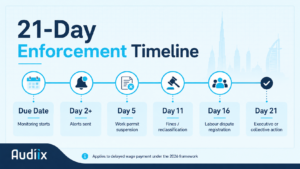
The new Resolution introduces structured, expedited enforcement for delayed wage payment. The timeline below is based on Annex No. (1) of Ministerial Resolution No. (0340) of 2026. Note: The “due date” is the first day of each Gregorian month for the preceding month’s wages.
| Timeline | Regulatory Action |
| Due Date | Electronic monitoring begins for all establishments |
| Day 2+ | Notifications and alerts sent to non-compliant establishments |
| Day 5 | Suspension of new work permit issuance; establishment owner notified |
| Day 11 | Administrative fine imposed (repeated violation within 6 months)
Third Category reclassification (under Ministerial Resolution No. (209) of 2022) |
| Day 16 | Automatic registration of individual or collective labour dispute
Suspension of work permit issuance (applies to establishments with 25+ workers or aggregated structures) |
| Day 21 | Executive instrument for payment (establishments <50 workers)
Collective labour dispute procedures (50+ workers) Possible precautionary attachment, travel ban on person in charge, and referral to Public Prosecution |
Important: Conditional Application of Sanctions
Not every sanction applies automatically to every case. Some measures apply only where conditions in Annex No. (1) are met:
- Day 11 sanctions: Apply to non-compliant establishments in cases of repeated violations within 6 months
- Day 16 measures: Apply to non-compliant establishments with 25+ workers or aggregated structures in specified sectors (construction, transport and storage, security services, cleaning services, recruitment, domestic worker recruitment)
- Day 21 escalation: Applies to repeated violations involving larger establishments, aggregated structures, or where labour market stability is at risk
Detailed Look: Key Change 4 – Delegated Payroll Responsibility
The new Resolution permits establishments to delegate wage payment to a third party (e.g., payroll service providers, group payroll companies, HR outsourcing platforms, employer-of-record arrangements). However, delegation is regulated and comes with important limitations.
Delegation Requirements
- The establishment must provide the delegate’s data to the Ministry
- A copy of the delegation agreement or contract must be submitted, including scope of delegation and limits of obligations and responsibilities
Establishment Liability Survives Delegation
The establishment remains responsible for paying wages on time. If the delegate fails to pay wages by the due date, the Resolution’s enforcement procedures will be applied against the establishment, not the delegate. The delegate’s liability to the establishment depends on applicable legislation and the contractual arrangement between them.
For Employers: Critical Action Items
- Review and update payroll delegation agreements to define responsibilities, payment timelines, and data submission obligations
- Ensure service-level agreements include escalation procedures and liability for missed payment deadlines
- Submit delegation details and delegate data to the Ministry as required by the Resolution
- Do not assume that outsourcing payroll removes regulatory liability for wage payment compliance
WPS Exclusions Under the New Resolution
Certain workers and employers are excluded from WPS requirements. These exclusions are specific and often require Ministry notification or documentation:
Worker-Level Exclusions
- Workers with wage-related labour claims referred to a competent court, or subject to an executive instrument, within the limits of the wage or period subject to the claim
- Workers against whom an absconding report has been filed during the validity of that report
- Workers whose liberty is restricted by an order or judgment issued by a competent authority, during the period in which work cannot be performed, provided that the Ministry is notified and supporting documents are submitted
- Workers on approved unpaid leave (Ministry notification and required documents mandatory)
- Seafarers working on ships (based on establishment request and Ministry decision)
- Foreign workers employed by foreign establishments or UAE branches receiving wages outside the UAE (based on establishment request and worker approval)
- Workers holding mission work permits with duration not exceeding three months
Establishment-Level and Sectoral Exclusions
- Fishing boats owned by individual citizens
- Public taxis owned by individual citizens
- Banks and financial institutions
- Places of worship
Important Caution on Exclusions
Employers should exercise caution when relying on an exclusion. Some exclusions require Ministry notification, supporting documents, worker approval, establishment request, or Ministry decision. Failure to meet procedural requirements may invalidate the exclusion and trigger enforcement action.
UAE WPS Rules 2026 vs 2022: What Has Changed
The 2026 Resolution materially tightens the WPS compliance framework. Key differences from the 2022 regime:
- Unified wage due date: Wages are now due on the first day of each Gregorian month (replaces variable due dates)
- No 15-day delay threshold: Payment after the due date is treated as delayed (2022 framework allowed 15 days)
- Higher WPS compliance threshold: Increased from 80% to 85% of total wages due
- Earlier work permit suspension: Suspension of new work permits may occur on Day 5 (compared to later under 2022 regime)
- Express payroll delegation rules: New Resolution clarifies delegation procedures while maintaining establishment liability
- Revised exclusions: The 2022 framework’s 30-day exclusion for new employees does not appear in the 2026 Resolution
Employer Compliance Roadmap
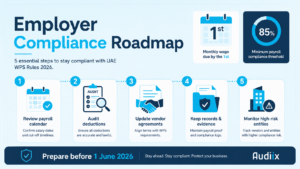
Businesses should prepare before 1 June 2026. The following roadmap outlines key steps:
Step 1: Payroll Calendar Review
- Review the payroll calendar for each month and work backwards from the 1st of the month.
- Review employment contracts, payroll policies, and internal HR templates that refer to wage payment dates after the 1st of the month. Even where contract wording is not immediately amended, payroll operations should be aligned with the new statutory due date.
- Identify critical dates: payroll approval deadlines, WPS submission deadlines, banking cut-off times.
- Adjust for public holidays, weekends, and month-end banking delays.
- Ensure payroll funding is approved and available before the first day of the month.
Step 2: Wage Deductions and Withholdings Audit
- List all types of wage deductions and withholdings (statutory, contractual, disciplinary, etc.)
- Verify that each deduction is legally permissible under UAE labour law
- Maintain clear records documenting the legal basis and calculation methodology for each deduction
- Review unpaid leave records and labour dispute claims to ensure WPS compliance
- Update WPS reporting controls to ensure 85% threshold is met at establishment and worker levels
Step 3: Payroll Vendor and Delegation Agreements
- If using payroll service providers, update or create delegation agreements and contracts
- Clearly define scope of delegation, data submission obligations, and responsibility for payment deadlines
- Include escalation procedures and accountability mechanisms in case of missed deadlines
- Prepare delegation documentation for Ministry submission
- Do not assume that payroll outsourcing removes the establishment’s regulatory liability
Step 4: Documentation and Compliance Evidence
- Establish a documentation system to track wage payment evidence and proof of on-time WPS submission
- Maintain copies of all Ministry notifications regarding approved unpaid leave
- Document worker approvals required for certain exclusions
- Retain supporting documentation for any claimed WPS exclusion
Step 5: High-Risk Sector Compliance
If your business operates in construction, transport and storage, security services, cleaning services, recruitment, or domestic worker recruitment—or has multi-entity structures in these sectors—pay special attention to same-employer aggregation rules:
- Identify all entities within your control or common ownership
- Monitor the aggregate number of unpaid workers across these entities
- Ensure that the combined number does not reach 25 or more unpaid workers, which would trigger Day 16 enforcement measures
FAQ: UAE WPS Rules 2026
What are the new UAE WPS rules 2026?
The UAE WPS rules 2026 introduce a unified wage due date, an 85% WPS compliance threshold, faster enforcement for delayed wage payment, and clearer payroll delegation rules.
When do the UAE WPS rules 2026 take effect?
The new framework takes effect on 1 June 2026. Employers should prepare on the basis that wages for the preceding month must be paid by the first day of each Gregorian month.
Can employers pay only 85% of wages under the UAE WPS rules 2026?
No. The 85% threshold is a WPS compliance measurement only. Workers remain entitled to their full wages, subject only to lawful deductions or withholdings.
Key Takeaway for UAE Employers
The new UAE WPS rules 2026 Resolution raises the standard for wage payment compliance. From 1 June 2026, the first day of each Gregorian month becomes a hard payroll compliance deadline.
The combination of a unified due date, an 85% compliance threshold, Day 5 work permit suspension, rapid dispute escalation, and express delegation rules means wage payment must be managed as a monthly legal compliance priority.
Simple Compliance Formula
- Pay on time—by the 1st of each Gregorian month
- Pay through the approved WPS system
- Document all wage deductions and their legal basis
- Verify any claimed WPS exclusion meets Ministry requirements
- Do not assume that outsourcing payroll removes establishment liability