Ministerial Decision No. 24 of 2026 has been issued to supplement Cabinet Decision No. 215 of 2025, together establishing a Research and Development (R&D) Tax Credit framework within the UAE Corporate Tax (CT) and Domestic Minimum Top-up Tax (DMTT) regimes. The regime marks a significant step in the UAE’s commitment to supporting innovation and future-focused business activity.
That said, the R&D Tax Credit is not an automatic tax deduction or a general innovation allowance. It is a pre-approval-based tax credit regime that requires eligible UAE-based R&D activities, qualifying expenditure, minimum R&D staff levels, audited financial statements, and robust technical and financial documentation.
In practice, this makes the R&D Tax Credit not only a tax matter, but equally an accounting, documentation, project governance, and financial reporting matter. To benefit, businesses must demonstrate that their R&D activities qualify, that the work is carried out in the UAE, that expenditure is properly tracked, and that each project has been pre-approved.
This article provides a practical overview of the R&D Tax Credit regime and what UAE Taxable Persons should consider before seeking to claim it. For UAE businesses, the UAE R&D Tax Credit should be planned before project costs are incurred, not only when the Corporate Tax return is being prepared.
Why This Matters for UAE Businesses
For companies investing in technology, product development, engineering, scientific work, or process innovation, the R&D Tax Credit may reduce future Corporate Tax or Domestic Minimum Top-up Tax liabilities.
However, the benefit depends on more than the idea itself. Businesses will need to demonstrate:
- What the R&D project is trying to achieve;
- Why the outcome is technically uncertain;
- Which staff worked on the project;
- Which costs relate to qualifying R&D activities;
- Whether the expenditure was incurred in the UAE;
- Whether the project was properly documented and approved.
This is where many businesses may struggle. If the accounting records, cost allocation, staff time records, and project documentation are not clear from the start, the tax credit may be difficult to support later.
Key Highlights at a Glance
| Feature | Detail |
| Effective date | Tax periods / fiscal years commencing on or after 1 January 2026 |
| Maximum credit | AED 2 million per tax period / fiscal year per Qualifying Entity (or Tax Group) |
| Credit rates | 15% / 35% / 50% (tiered, based on expenditure and headcount) |
| Refundability | Non-refundable; may offset CT or DMTT liability |
| Carryforward | Permitted (subject to conditions) |
| Transfer | Permitted between 75%+ commonly owned entities (subject to conditions) |
| Pre-approval | Required from the Emirates Research and Development Council (ERDC) |
Who Qualifies for the UAE R&D Tax Credit?
To access the R&D Tax Credit, an entity must meet the definition of a Qualifying Entity under the CD. Two categories of entity are eligible:
UAE juridical persons — entities incorporated, established, or recognised in the UAE, including Free Zone Persons, that are subject to CT and/or Top-up Tax and carry on Qualifying R&D Activities.
Foreign entities with a UAE Permanent Establishment (PE) — entities incorporated under foreign law that carry on Qualifying R&D Activities through a UAE PE and are subject to CT and/or DMTT on income attributable to that PE.
Note for Qualifying Free Zone Persons: A Qualifying Free Zone Person is not automatically eligible merely because it carries out R&D in the UAE. To claim the R&D Tax Credit, it must either:
- Be subject to UAE Corporate Tax at the 9% rate on Taxable Income derived from the Qualifying R&D Activities during the relevant Tax Period; or
- Be subject to Top-up Tax for the relevant Fiscal Year.
This means that R&D income benefiting from the 0% Qualifying Free Zone regime will not, by itself, support an R&D Tax Credit claim. For wider structuring considerations, see our guide on how your UAE company structure affects your tax position.
Who is Excluded?
The following entities are ineligible for the R&D Tax Credit:
- Entities outside the scope of CT or DMTT
- Entities that have elected to apply Small Business Relief
- Certain other entities specified by Ministerial Decision
Qualification Criteria
Beyond satisfying the Qualifying Entity definition, an entity must continuously meet all of the following eligibility criteria:
- A minimum number of employees engaged in Qualifying R&D Activities (see Table 1)
- A minimum level of Qualifying R&D Expenditure (see Table 1)
- The entity must bear the financial risk of the R&D activities and benefit from their results
- The relevant R&D Project must have a specific objective to expand the stock of knowledge or to develop new applications for existing knowledge
- Pre-approval must be obtained from the ERDC for each R&D Project
The Qualifying R&D Activities must be conducted in the UAE. Where an R&D Project is carried out partly inside and partly outside the UAE, only the UAE-based activities may qualify.
How the UAE R&D Tax Credit is Calculated
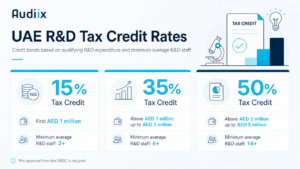
The R&D Tax Credit is calculated by applying the relevant rate to each portion of Qualifying R&D Expenditure falling within the applicable expenditure band. To access a specific rate, the Qualifying Entity or Tax Group must meet both the expenditure threshold and the minimum average R&D Staff threshold for that band. If either threshold is not met, the rate is adjusted downward to the highest band for which both conditions are satisfied.
Table 1 — Tiered R&D Tax Credit Rates
| Portion of Qualifying R&D Expenditure | Minimum average R&D Staff | Tax Credit rate |
| First AED 1 million* | At least 2 | 15% |
| Portion above AED 1 million up to AED 2 million | At least 6 | 35% |
| Portion above AED 2 million up to AED 5 million | At least 14 | 50% |
*A separate minimum threshold applies at project level: Qualifying R&D Expenditure must amount to at least AED 500,000 for each R&D Project in the relevant Tax Period or Fiscal Year, excluding the staff cost overhead uplift.
Important notes:
- Expenditure must be wholly and exclusively incurred in respect of Qualifying R&D Activities. Where expenditure is incurred for multiple purposes, apportionment is required.
- A separate project-level minimum applies: Qualifying R&D Expenditure must be at least AED 500,000 for each R&D Project in the relevant Tax Period or Fiscal Year, excluding the staff cost overhead uplift. This AED 500,000 threshold is not itself a credit-rate band.
- For Tax Groups, the Qualifying R&D Expenditure and R&D Staff of all Qualifying Entities within the Tax Group are aggregated for the purpose of applying the expenditure and staff thresholds. Where a Qualifying Entity is a member of a Tax Group, the Parent Company is responsible for applying for pre-approval, submitting the R&D Tax Credit claim as part of the Tax Return, and complying with the relevant claim obligations.
- Where an entity fails to meet both the expenditure and headcount criteria for a given tier, the applicable rate is adjusted downward to the highest tier where both criteria are satisfied.
What Counts as a “Qualifying R&D Activity”?
Consistent with the OECD Frascati Manual, a Qualifying R&D Activity is any activity conducted in the UAE as part of an R&D Pr oject that satisfies all five of the following criteria:
- Novel — aims to produce new findings
- Creative — based on original concepts or hypotheses
- Uncertain — the outcome or the means of achieving it is not known in advance
- Systematic — conducted according to a defined plan and budget
- Transferable or reproducible — the results can be applied or replicated in other contexts
Activities conducted in the fields of social sciences, humanities, and arts are expressly excluded by the MD.
What Counts as “Qualifying R&D Expenditure”?
The CD prescribes specific categories of expenditure that qualify, provided they are incurred by a Qualifying Entity in the relevant Tax Period in connection with Qualifying R&D Activities.
Table 2 — Eligible Expenditure Categories: Key Rules and Conditions
| Expenditure Category | Key Rules and Conditions |
| Staff costs | Covers salaries, allowances, medical insurance, pension contributions, gratuity, bonuses, benefits in kind, and R&D training costs. Excludes stock option plans and intra-Tax Group recharges. Staff must be UAE-based and under the Qualifying Entity’s control. A 30% overhead uplift applies on eligible staff costs. |
| Consumable costs | Covers consumable or transformable materials directly used in Qualifying R&D Activities (e.g., water, fuel, power, licence fees, clinical trial participant payments). Excludes materials disposed of in the ordinary course of business for consideration and intra-Tax Group acquisitions. |
| Subcontract fees | Covers R&D activities subcontracted to a UAE-based person, performed within the UAE, on arm’s length terms where between related parties. Excludes intra-Tax Group subcontracting and expenditure attributable to a foreign PE. Chain subcontracting is excluded, and related-party subcontractors must maintain audited financial statements. |
| Cost contribution arrangements | Multi-party arrangements to share contributions and risks in jointly conducted R&D, where each party is expected to benefit. Only activities performed in the UAE qualify. Arm’s length pricing and benefit-proportionality conditions must be met. |
| Capitalised R&D costs | Any of the above categories that are capitalised under applicable accounting standards in respect of internally developed intangible assets arising from Qualifying R&D Activities. Standard eligibility conditions still apply. |
General Conditions Applicable to All Expenditure Categories
For any item of expenditure to qualify, the following conditions must all be met:
- A minimum of AED 500,000 in Qualifying R&D Expenditure per Tax Period per R&D Project (excluding the staff cost overhead uplift)
- Expenditure must be wholly and exclusively incurred for Qualifying R&D Activities (with apportionment required for dual-purpose costs)
- Expenditure must be deductible for CT purposes, unless it qualifies as Capitalised R&D Costs
- The portion of expenditure directly or indirectly funded by a Grant is excluded
- Expenditure may not be subject to any other tax incentive, credit, exemption, or relief in the UAE
Credit Cap
Based on the expenditure bands in Ministerial Decision No. 24 of 2026, the maximum R&D Tax Credit is effectively AED 2 million per Qualifying Entity or Tax Group per Tax Period or Fiscal Year, assuming the relevant expenditure and R&D Staff thresholds are met. This is because the credit applies up to AED 5 million of Qualifying R&D Expenditure, across the 15%, 35%, and 50% bands.
Utilisation: Ordering Rules
The MD sets out a prescribed utilisation sequence for R&D Tax Credits, broadly mirroring the approach taken for tax losses:
- Current-year credit first — the credit for the current period must first be applied against the entity’s CT and/or Top-up Tax liability for that period before any amount is carried forward or transferred. For Tax Groups, a member’s current-year credit is first applied against the Tax Group’s Corporate Tax liability.
- Chronological ordering of multi-year credits — where credits from multiple Tax Periods are available, earlier-period credits must be utilised first. Within a Tax Group, pre-grouping R&D credits are utilised before the Tax Group’s own credits.
- Pillar Two / DMTT ordering — for entities within a Domestic Group for Pillar Two purposes, the R&D Tax Credit may be applied against the Domestic Group’s Top-up Tax liability, but only after it has first been used against the relevant CT liability of the entity, Tax Group, or eligible transferee.
Carryforward of Unused Credits
Unused R&D Tax Credits may be carried forward to subsequent tax periods, subject to the following ownership continuity conditions:
- The same owners hold at least 50% ownership in the Qualifying Entity throughout the relevant period; or
- Where an ownership change exceeding 50% occurs, the entity continues the same or a similar business.
The carryforward mechanism is not available to Qualifying Entities whose shares are listed on a Recognised Stock Exchange.
Transfer of Unused Credits
Unutilised R&D Tax Credits may be transferred to another juridical person (provided that person is subject to CT or DMTT), where:
- Both entities are at least 75% commonly owned (directly or indirectly), or one owns the other by that percentage; and
- That ownership threshold is maintained throughout the applicable period.
The amount transferred cannot exceed the transferee’s CT or DMTT liability for the relevant Tax Period after applying its own R&D Tax Credits.
Credits may also be transferred in the context of a business restructuring, provided the transferee continues the business and associated R&D activities for a minimum of two years post-transfer.
Anti-Abuse Provisions and Clawback
The R&D Tax Incentive Regime incorporates a series of clawback mechanisms that may require repayment of previously utilised credits and/or forfeiture of unutilised credits. These are triggered in the following circumstances:
- Anti-abuse — any arrangement that lacks genuine economic substance or R&D character and is designed to obtain or inflate an R&D Tax Credit
- Artificial business separation — deliberately splitting a business across multiple entities to remain within expenditure thresholds while collectively exceeding the permitted cap
- Business restructuring — where credits are transferred to a successor entity and that entity fails to continue the business and associated R&D activities for at least two years
- Loss of eligibility — where, within five years from the end of the Tax Period or Fiscal Year in which the R&D Tax Credit was last claimed, the Qualifying Entity ceases to be a Taxable Person, becomes a Qualifying Free Zone Person, applies Small Business Relief, enters liquidation, or redomiciles outside the UAE. In these cases, utilised R&D Tax Credits may be clawed back as Payable Tax or Due Tax, and unutilised credits may be forfeited, unless the business restructuring exception applies
UAE R&D Tax Credit Compliance Requirements
Claiming the R&D Tax Credit requires satisfying a number of procedural obligations:
- ERDC Pre-Approval An application must be submitted to the Emirates Research and Development Council (ERDC) in the prescribed form and manner to obtain pre-approval for each Qualifying R&D Project prior to claiming the credit. Further guidance on the application process and approval timelines is expected.
- Tax Return Filing The R&D Tax Credit claim must be submitted as part of the relevant CT Return or Top-up Tax Return.
- Supporting Documentation
The credit claim must be accompanied by:
- proof of pre-approval from the Emirates Research and Development Council;
- a signed declaration by senior management confirming the accuracy of the information provided;
- a breakdown of Qualifying R&D Expenditure in the form required by the Authority;
- audited financial statements of the Qualifying Entity; and
- any other information or documents specified by the Minister, the Authority, or the Council.
In practice, businesses should also maintain a technical R&D file for each project, including project objectives, hypotheses, technical uncertainties, methodologies, experiments, progress reports, results, staff time records, cost allocation workings, and evidence linking each expenditure category to the approved R&D Project. Strong accounting records are also essential; for related guidance, see our article on UAE subsidiary tax and accounting requirements.
Practical Takeaways
The R&D Tax Incentive Regime is a important development in the UAE Corporate Tax environment and a clear signal of the country’s commitment to fostering domestic innovation. However, the regime’s tiered structure, ownership continuity requirements, anti-abuse provisions, and pre-approval obligations make careful advance planning essential.
Entities considering a credit claim should take note of the following:
- Seek tax advice early to confirm eligibility, structure qualifying expenditure correctly, and navigate the ERDC pre-approval process.
- M&A considerations — acquirers should assess whether a target holds unused R&D Tax Credits and whether the acquisition could trigger a clawback. Conversely, the ability to transfer credits to an acquiree may represent meaningful deal value.
- Free Zone interactions — Free Zone Persons, especially those seeking or maintaining Qualifying Free Zone Person status, should carefully assess whether the R&D income or expenditure is subject to the 0% Free Zone regime, the 9% Corporate Tax rate, or Top-up Tax. The R&D Tax Credit is not intended to be combined with another UAE incentive, credit, exemption, or relief for the same expenditure.
- DMTT treatment — multinational groups subject to UAE Domestic Minimum Top-up Tax should separately assess how the non-refundable R&D Tax Credit is treated for Pillar Two / DMTT purposes, including its impact on Top-up Tax liability and effective tax rate calculations