The Question Most Business Owners Ask Too Late
Salary vs dividends in the UAE is one of the most debated Corporate Tax questions for founders and owner-managed businesses, and one of the most frequently misframed. The question usually goes something like this: “Should I pay myself a salary or take dividends?” It is a reasonable starting point. But for UAE Corporate Tax purposes, the answer begins somewhere else entirely.
The better question is: What is the real nature of this payment, and who is legally paying whom?
That second part matters more than most business owners realise. A founder who owns shares in a UAE company is not in the same tax position as a natural person running a sole establishment. A company can pay a founder for services because the company and the founder are legally separate persons. A sole establishment is different: for UAE Corporate Tax purposes, the individual and the business are generally treated as one and the same Taxable Person.
That structural distinction, not the label on the payment, is what determines how UAE Corporate Tax applies. Before deciding between salary, dividends, bonuses, benefits, or withdrawals, the essential first step is to identify the legal form of the business and the true nature of the payment.
Who this article applies to: This guide covers UAE companies and similar incorporated entities, including LLCs, FZCOs and FZEs, and explains how the treatment differs for sole establishments and natural person businesses. Shareholder loans, capital repayments, partner withdrawals, liquidation distributions and intercompany arrangements are outside the scope of this article and should be reviewed separately.
Before You Decide: Legal Form Changes Everything
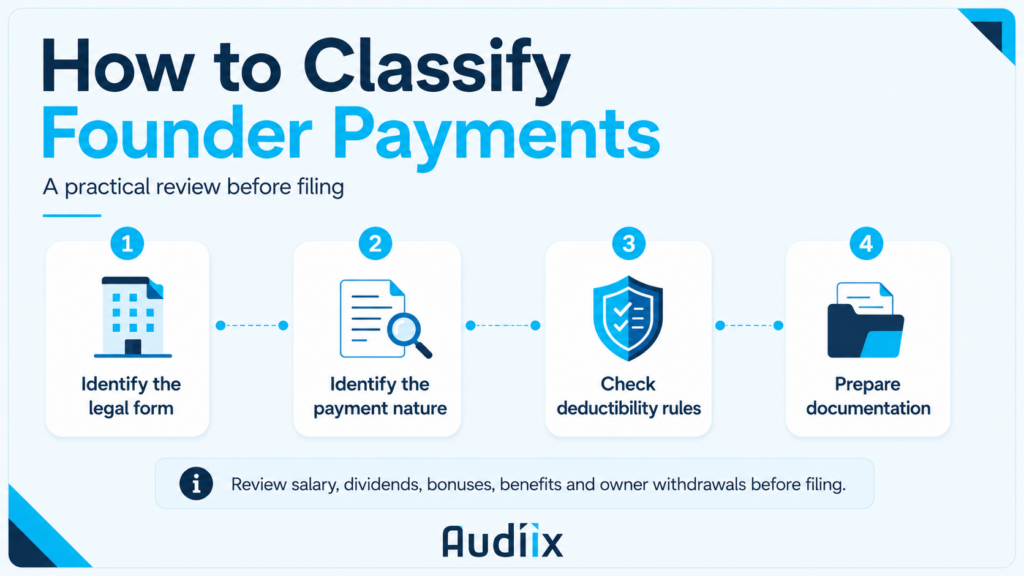
Before any discussion of salary versus dividends, there is a more fundamental question: what is the legal structure of the business, and what is the true nature of the payment?
The UAE Corporate Tax rules do not treat all owner payments in the same way. A UAE company can pay a founder for services because the company and the founder are separate legal persons. If the founder genuinely works in the business, a properly supported salary, bonus, or employment benefit may be deductible for Corporate Tax purposes, subject to the relevant legal conditions.
A sole establishment or sole proprietorship is different. It is owned and conducted by a natural person on their own account. For UAE Corporate Tax purposes, the natural person conducting the business is the Taxable Person, not the sole establishment as a separate entity. This means the owner cannot create a deductible salary by paying themselves from their own business. Even where the amount is recorded in the accounts as salary, it is treated as an owner withdrawal and is not deductible in calculating Taxable Income, as confirmed under Article 33(5) of the UAE Corporate Tax Law.
Before any salary-versus-dividends decision is made, the right questions to address are:
- Is the payer a UAE juridical person, such as an LLC, FZCO, or FZE?
- Is the founder being compensated as an employee, director, officer, or shareholder?
- Is the payment genuinely for services rendered, a return on ownership, an owner withdrawal, or something else?
- Are the amounts properly approved, recorded, and commercially supportable?
The real issue is not salary versus dividends. It is classification, and classification begins with legal form.
Salary vs Dividends in the UAE: The Core Corporate Tax Difference
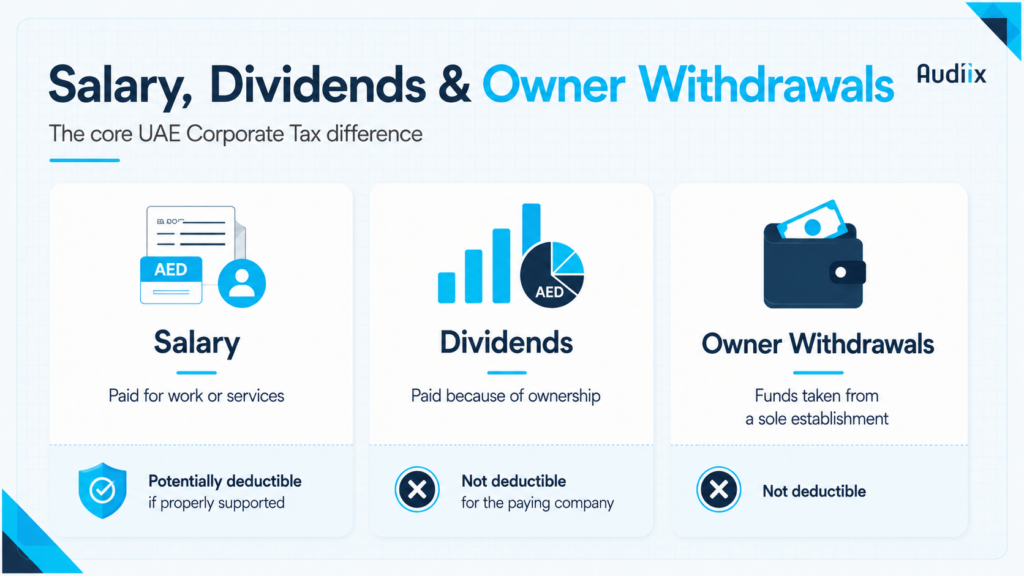
The words used in the accounts must match the substance of the payment. A salary, bonus, or employment benefit is paid because someone works in the business, it is compensation for services, responsibility, time, skill, and performance. A dividend is paid because someone owns shares or an ownership interest, it is a distribution to an owner in their capacity as shareholder or equity holder. An owner withdrawal from a sole establishment is different again: it is not a company paying an employee, but an individual taking funds from their own business. The table below summarises the key differences across all three.
| Payment type | Why it is paid | Corporate Tax treatment | Main risk |
| Salary, bonus or employment benefit paid by a company | Compensation for work, services, responsibility or performance | Potentially deductible if the conditions are met | Excessive or unsupported remuneration may be disallowed |
| Dividend or profit distribution paid by a company | Return to the owner because they hold shares or an ownership interest | Not deductible under the Corporate Tax Law | Misclassifying owner distributions as deductible salary or bonus |
| Withdrawal by a natural person from a sole establishment | Owner taking funds from their own business | Not deductible under the Corporate Tax Law | Recording owner withdrawals as “salary” even though the owner and business are one Taxable Person |
In a founder-led company, both salary and dividends can be entirely legitimate. A founder can work in the business and own the business at the same time. What determines the tax treatment is not the founder’s status, but whether each payment is correctly classified, commercially supportable, and properly documented.
When Founder Salary Is the Right Move
A founder salary is generally appropriate where the founder genuinely works in the company, not in a nominal sense, but substantively. Managing the team, making commercial decisions, building the product, developing client relationships, handling operations, signing contracts, supervising finance, or driving revenue all constitute genuine work that may support a salary deduction.
For a UAE company, the starting point is Article 28 of the Corporate Tax Law: expenditure must be incurred wholly and exclusively for the purposes of the Business and must not be capital in nature. Where the payment is made to a Related Party, Article 34 requires the transaction to satisfy the Arm’s Length Principle. Where the payment or benefit is made to a Connected Person, Article 36 restricts the deduction to the extent it corresponds with the Market Value of the service or benefit provided and is incurred wholly and exclusively for the Business.
A founder salary can therefore be deductible, but not simply because the company paid it. The company must be able to demonstrate what role the founder performs, why the company needs that role, what responsibilities and decisions it involves, how the salary amount was determined, why it is commercially reasonable, that the payment was properly approved and recorded, and that the amount was not chosen after year-end simply to reduce taxable profit.
A strong documentation file will typically include an employment contract or service agreement, a job description, payroll and bank records, board or shareholder approval where appropriate, and a clear, contemporaneous basis for the remuneration amount. The UAE Corporate Tax regime is not hostile to founder salaries. It simply requires them to reflect commercial reality.
Bonuses and Employment Benefits: The Same Logic, With a Higher Evidence Burden
Bonuses and employment benefits are legitimate components of founder remuneration. They should be approached with the same rigour as salary, arguably greater rigour, because they are often more variable, less predictable, and harder to benchmark against comparable market data.
A defensible bonus requires a clear business rationale, a documented link to performance, results, milestones, revenue, profitability, or strategic outcomes, a calculation basis established before or around the time of award, and accounting treatment consistent with the company’s financial records. Large bonuses constructed after the year ends, with no prior policy, no performance criteria, and no approval trail, will attract closer scrutiny under a Related Party or Connected Person review.
Employment benefits follow the same principle. Medical insurance, business travel, phone and housing allowances, a company vehicle with a documented business allocation, or education allowances can all be legitimate components of a remuneration package when properly approved, recorded, and commercially supportable. The issue is not whether a benefit has personal value, many employment benefits do. The question is whether the benefit genuinely forms part of remuneration and whether it can be demonstrated as such.
The clearest risk is when purely personal expenditure is embedded in business costs: private family holidays, personal shopping, household expenses, or personal credit card charges with no employment basis. The principle is straightforward in every case:
If it is remuneration, classify and document it as remuneration. If it is personal, it does not belong in the company’s expense records.
The Related Party and Connected Person Rules: What Founder-Led Businesses Often Miss
This is the area that catches many UAE founder-led businesses unprepared, often only surfacing when a Corporate Tax Return comes under review. When the person being paid is also an owner, director, officer, shareholder, or related person, the UAE Corporate Tax rules require an additional layer of justification beyond ordinary payroll support.
The key provisions are Article 28 (business purpose), Article 34 (Arm’s Length Principle for Related Party transactions), Article 35 (definition of Related Parties and Control), and Article 36 (restriction on deductions for payments or benefits to Connected Persons to the extent they correspond with Market Value and are incurred wholly and exclusively for the Business). Together, these rules mean that founder remuneration cannot be justified simply by company approval or a founder’s own assessment of what they deserve.
The company needs objective evidence that the amount is commercially reasonable given the founder’s role, time commitment, seniority and experience, the size and complexity of the business, revenue, profitability and team scale, industry norms, and what a comparable external hire would cost. For many smaller UAE businesses, this may not require a Master File, Local File or detailed transfer pricing report, unless the relevant thresholds or risk profile require it. However, the company should still maintain proportionate evidence showing how the remuneration was determined and why it is commercially reasonable. A proportionate benchmarking file, salary surveys, comparable job advertisements, recruiter data, internal pay comparisons, a short functional analysis, and management notes explaining the commercial rationale, is typically sufficient. The more variable, unusual, or high-value the payment, the stronger the supporting evidence should be.
Under Article 55 of the Corporate Tax Law, disclosure of Related Party and Connected Person transactions may also be required in the Corporate Tax Return. This is not a formality to address after filing, it is a structural part of the tax position itself, and it requires a deliberate assessment before submission.
The 2026 FTA Clarification: What “Director” and “Officer” Mean for UAE Founders
In April 2026, the FTA issued Public Clarification CTP010 on the meaning of “director” and “officer” in the context of payments to Connected Persons under Article 36 of the Corporate Tax Law. This clarification has direct implications for founders and owner-managers across the UAE.
The clarification confirms that a formal job title is not determinative. A director is a person who holds a position on the board of directors or an equivalent governing body, based on the applicable law and constitutional documents of the Taxable Person, not simply someone whose business card carries the word “Director.” An officer is defined more broadly: it encompasses any person with authority and responsibility for planning, directing, and controlling the company’s activities, authority to make final strategic financial, operational, or commercial decisions, or authority to enter into agreements or approve actions that legally or contractually bind the Taxable Person. The clarification also confirms that a person without final or ultimate strategic decision-making or binding authority is not an officer merely by virtue of a senior title.
CTP010 also clarifies that where a person is both a Related Party and a Connected Person of a Taxable Person, that person is treated as a Related Party for Corporate Tax purposes. The practical consequence for risk management is the same in either scenario: the relationship must be identified, the payment must be commercially supportable, and the Corporate Tax Return position must be reviewed and documented before filing.
For UAE founders, the practical implication is direct: if you run the company, make strategic decisions, control commercial activity, or sign binding contracts, you may be treated as an officer depending on your actual authority and responsibilities, regardless of job title. This is not a risk to ignore, it is a position to manage properly through documentation and Market Value support.
Dividends in the UAE: When Ownership Is the Reason for the Payment
Salary vs dividends in the UAE is not a simple tax-efficiency comparison. It is a categorically different kind of payment, a distribution to an owner in their capacity as shareholder or equity holder, and that distinction is fundamental to how UAE Corporate Tax treats it.
A salary is paid because someone works. A dividend is paid because someone owns. For the paying company, dividends, profit distributions, and benefits of a similar nature paid to an owner are explicitly not deductible under Article 33(4) of the Corporate Tax Law. This is not a penalty on distributions. It reflects the nature of a dividend as a return of profit or equity value to an owner. A dividend is not an expense incurred to earn the company’s income. For this reason, dividends, profit distributions and benefits of a similar nature paid to an owner are not deductible under Article 33(4) of the Corporate Tax Law.
A dividend is appropriate where the company has distributable profits or retained earnings, where the distribution is permitted under applicable company law, free zone regulations, and constitutional documents, where it is properly approved and documented by the relevant shareholders or governing body, where the accounting treatment is clear, and where no Corporate Tax deduction is claimed by the paying company.
On the recipient side, Article 22(1) of the Corporate Tax Law provides that dividends and other profit distributions received from a UAE Resident juridical person are generally not included in calculating the recipient’s Taxable Income. For natural person shareholders, dividends received in a personal investment capacity are also distinguished from business income under the natural person rules. The company’s Corporate Tax position and the founder’s personal tax position are separate and should not be conflated in analysis or in the tax computation.
Common Mistakes UAE Founders and Business Owners Make
Founder and owner-manager remuneration creates problems when the records do not reflect reality. The following mistakes appear regularly in UAE founder-led businesses, and each of them is avoidable with straightforward preparation.
- Paying salary with no documented role.
If the company cannot explain what the founder does, why the role is needed, and how the salary amount was determined, the deduction is difficult to support under scrutiny. The position needs to be built before filing, not after a question is raised.
- Recording sole establishment withdrawals as salary.
A natural person running a sole establishment cannot create a deductible salary by paying themselves from their own business. For Corporate Tax purposes, the owner and the sole establishment are treated as one Taxable Person. The deduction does not become available simply by labelling the withdrawal as salary in the accounts.
- Approving large year-end bonuses with no prior basis.
Bonuses should have a documented rationale and calculation basis established before, or at least around, the time of award. A bonus constructed after the taxable profit position is known, with no prior performance policy or criteria, will attract greater scrutiny in a Related Party or Connected Person review.
- Mixing personal and business expenses.
This creates Corporate Tax risk and distorts the financial statements simultaneously. The effects extend beyond tax: mixed expenses compromise management reporting, weaken audit readiness, undermine investor confidence, and make business valuations harder to rely on.
- Treating dividends as deductible expenses.
Dividends and profit distributions to owners are not deductible for the paying company under Article 33(4). This is a straightforward disallowance, and it applies regardless of how the payment is characterised in the accounts.
- Ignoring Related Party and Connected Person rules.
These rules are not limited to large multinationals or cross-border arrangements. They apply to domestic UAE structures and are fully relevant to founder-led companies paying remuneration to owners, directors, or officers. Assuming they do not apply without analysis is a risk that is difficult to correct after filing.
- Reconstructing documentation after the fact.
Documentation prepared in response to a query, after the Corporate Tax Return has been filed, carries far less weight than records created contemporaneously. The file should reflect how decisions were actually made, at the time they were made.
What Good Records Actually Look Like
Under Article 56 of the UAE Corporate Tax Law, Taxable Persons must keep records and documents for seven years after the end of the relevant Tax Period. For founder remuneration, this means the documentation must exist as a contemporaneous record, not as a reconstruction prepared after the fact.
For salary, bonuses, and employment benefits, a complete file will include an employment contract or service agreement, a job title and role description, evidence of actual work performed, payroll and bank records, a bonus policy or calculation worksheet, approval records, market salary benchmarking, and the working papers supporting the Corporate Tax computation. The file should tell a coherent, self-contained story about the role, the amount, and why the payment is commercially justifiable.
For dividends, the file should include accounting records confirming the available profits or retained earnings, the dividend calculation, board and shareholder approvals, bank payment confirmation, clear evidence that no Corporate Tax deduction was claimed, and confirmation that the distribution is permitted under the company’s constitutional documents and applicable regulations.
For Related Party and Connected Person positions, the file should include a related party and Connected Person register, an ownership and control analysis, Market Value or arm’s length support, benchmarking evidence proportionate to the size and risk of the payment, and the Corporate Tax Return disclosure assessment.
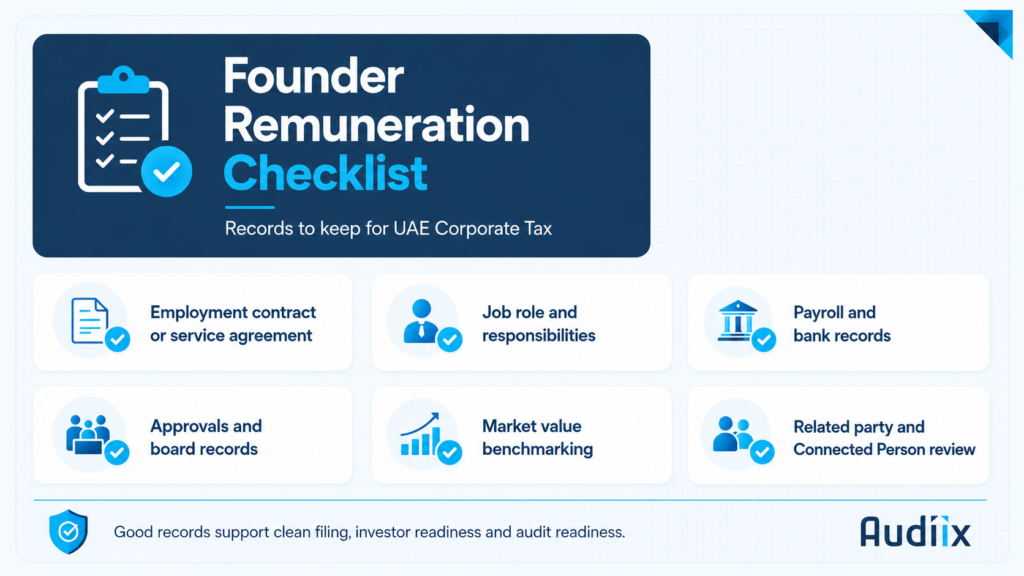
If the FTA, an auditor, an investor, or a potential buyer reviews the file at any point within the seven-year record-keeping period, the payment should be entirely self-explanatory, no reconstruction required.
Beyond Tax: Why This Matters for Your Business
The salary versus dividends question is not purely a Corporate Tax question. It is a business quality question, and founders who treat it as such will be in a substantially stronger position than those who address it only as a compliance requirement.
How a founder is paid affects how the business reads on paper. If founder remuneration is set too low, reported profit looks artificially high, making the business appear more scalable or profitable than the underlying economics justify. If it is too high and unsupported, taxable income may be understated and the financial accounts become unreliable as a management tool. If personal expenses are embedded in business costs, management reporting becomes distorted. If dividends are not properly approved and recorded, the equity position becomes difficult to verify.
Clean, well-documented founder remuneration matters across every dimension of business performance: monthly management accounts, tax computations, audit readiness, investor due diligence, EBITDA normalisation, business valuation, banking and financing discussions, and exit planning. For any founder-led business with growth ambitions, whether that means raising capital, restructuring, bringing in investors, or preparing for a future transaction, founder remuneration is not an administrative detail. It is part of the financial story the business tells.
The Bottom Line for UAE Founders and Business Owners
Salary or dividends is not a binary tax-planning choice. The correct answer depends on legal form, commercial substance, documentation, and compliance with the applicable Corporate Tax rules.
For a UAE company, salary, bonuses, and benefits may be deductible when they are genuinely incurred for services, supported by the business purpose test, commercially defensible under Market Value or arm’s length standards, and compliant with the Related Party and Connected Person rules. Dividends may be appropriate where the founder is receiving a return on ownership, but they are not deductible for the paying company.
For a sole establishment or natural person business, the owner cannot deduct a salary paid to themselves. Amounts withdrawn by the owner are treated as owner withdrawals under Article 33(5), not as business expenses, regardless of how they are recorded in the accounts.
Before filing any Corporate Tax Return, every founder-led business should review the legal form of the business, the nature and correct classification of each owner payment, whether the amounts are commercially supportable, whether Related Party or Connected Person rules apply and whether disclosure is required, and whether the documentation is complete, contemporaneous, and in place.
At Audiix, we work with founders, owner-managed businesses, and SMEs across the UAE to build clean accounting records, review Corporate Tax positions, document founder remuneration, assess Related Party and Connected Person risks, and prepare financial reports ready for tax filing, investor review, and strategic decision-making.
If you are unsure whether your salary, bonuses, employment benefits, dividends, or owner withdrawals are correctly structured and documented, the right time to review is before filing, not after a question is raised.