A practical update for UAE-resident SMEs, founders and finance teams on Ministerial Decision No. 131 of 2026.
Last updated: August 8, 2026
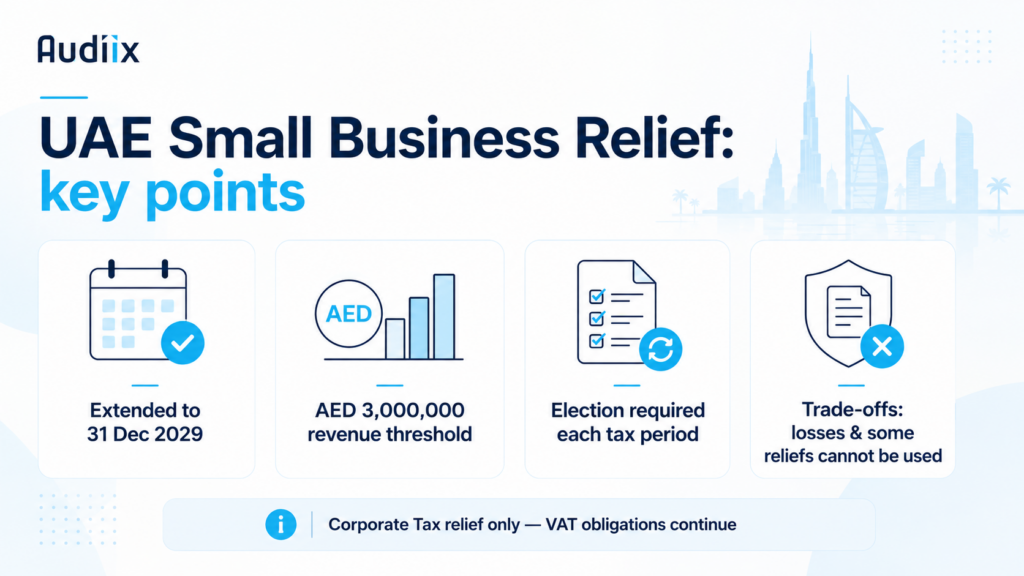
Small Business Relief in the UAE is now available for tax periods ending on or before 31 December 2029, three years longer than the original cut-off. The change came through Ministerial Decision No. 131 of 2026, issued on 29 July 2026, which replaced Clause 2 of Article 2 of Ministerial Decision No. 73 of 2023. Nothing else in the relief changed. The AED 3,000,000 revenue threshold, the eligibility conditions, and the trade-offs that come with electing all stay exactly as they were.
For most owner-managed businesses in the UAE, the useful question is not whether the relief still exists. It is whether electing for it in a given tax period is actually the better commercial decision, now that the runway is longer and the cumulative effect of electing year after year is larger.
Quick answer
- Small Business Relief lets an eligible UAE Resident Person elect to be treated as having no Taxable Income for a tax period, so no Corporate Tax is payable for that period.
- The revenue threshold is AED 3,000,000 in the relevant tax period and in all previous tax periods. It is unchanged.
- Following Ministerial Decision No. 131 of 2026, the relief applies to tax periods commencing on or after 1 June 2023 and ending on or before 31 December 2029.
- It is not automatic. You must be registered for Corporate Tax and make the election in the tax return for each tax period.
- Electing has trade-offs. A tax loss arising in a period where you elect cannot be accrued, used, transferred or carried forward. For taxable persons subject to the General Interest Deduction Limitation Rule, net interest expenditure arising in that period also cannot be carried forward. Qualifying Group transfer relief and Business Restructuring Relief are unavailable for that period.
What Ministerial Decision No. 131 of 2026 changed
Ministerial Decision No. 131 of 2026 is a short, single-purpose amendment. It replaced one clause and left the rest of Ministerial Decision No. 73 of 2023 in force.
| Before | After MD 131 of 2026 | |
| Revenue threshold | AED 3,000,000 | AED 3,000,000 (unchanged) |
| Tax periods covered | Commencing on or after 1 June 2023, ending on or before 31 December 2026 | Commencing on or after 1 June 2023, ending on or before 31 December 2029 |
| Eligibility conditions | Resident Person, not an MNE constituent company, not a Qualifying Free Zone Person | Unchanged |
| Effect of electing | No Taxable Income for the period, simplified return | Unchanged |
The decision was signed by the Minister of State for Financial Affairs and takes effect the day following its publication. Its stated legal basis is the Corporate Tax Law, Federal Decree-Law No. 47 of 2022, and Ministerial Decision No. 73 of 2023.
Which tax period is your last eligible one
The amended clause sets two conditions. The tax period must commence on or after 1 June 2023, and it must end on or before 31 December 2029. For working out your final eligible period, the cut-off that matters is the end date.
| Financial year end | Last eligible tax period |
| 31 December | 1 January 2029 to 31 December 2029 |
| 30 September | 1 October 2028 to 30 September 2029 |
| 30 June | 1 July 2028 to 30 June 2029 |
| 31 March | 1 April 2028 to 31 March 2029 |
A business with a non-calendar year end effectively gets slightly less of the extension than a calendar-year business, because the period straddling the end of 2029 falls outside the window. That is worth noting if you are modelling cash tax over the next few years.
What Small Business Relief in the UAE does, and what it does not do
Small Business Relief treats an eligible Taxable Person as having no Taxable Income for the relevant tax period. Two benefits follow. There is no Corporate Tax to pay on income earned in that period, and there is administrative relief: no requirement to calculate Taxable Income, and a simplified tax return.
A related point that often gets folded into the relief but is really a separate rule: a business eligible for Small Business Relief will also meet the AED 3,000,000 revenue condition in Ministerial Decision No. 114 of 2023 that permits financial statements to be prepared on the cash basis of accounting. The two rules sit alongside each other rather than one flowing from the other.
What it does not do is remove you from the Corporate Tax system. You remain a Taxable Person. Registration, filing, and record keeping continue.
It also has no effect on VAT. Small Business Relief is a Corporate Tax relief only. Your VAT registration, returns, and record-keeping obligations continue exactly as before.
Who can elect
You need to be a Resident Person for Corporate Tax purposes, either a natural person carrying on a taxable business or a juridical person, with revenue of AED 3,000,000 or less in the relevant tax period and in every previous tax period.
For a natural person there is a preliminary step before any of this matters. Corporate Tax applies to a natural person only where 1 in a Gregorian calendar year. Wage, Personal Investment income and Real Estate Investment income sit outside that figure. So a consultant with total Turnover of AED 700,000 from UAE Businesses or Business Activities in the calendar year does not need Small Business Relief to arrive at no Corporate Tax; that person is generally outside the regime to begin with. Small Business Relief becomes relevant once a natural person is inside the regime and is testing the AED 3,000,000 revenue condition.
Two categories are specifically excluded under Article 3 of Ministerial Decision No. 73 of 2023:
- Constituent companies of a Multinational Enterprise Group falling within the Country-by-Country Reporting framework referenced in Cabinet Resolution No. 44 of 2020 (broadly, groups meeting the AED 3.15 billion consolidated revenue threshold). A UAE subsidiary of such a group cannot elect, even if its own revenue is well under AED 3,000,000.
- Qualifying Free Zone Persons, who already benefit from a 0% rate on Qualifying Income.
A point that is often missed: a Free Zone company that is not a Qualifying Free Zone Person is a Resident Person and can elect, subject to the threshold. So can a Qualifying Free Zone Person that has elected to be subject to Corporate Tax under Article 19 of the Corporate Tax Law, since it is then treated as an ordinary Free Zone Person. If you are unsure which side of the line your entity sits on, that determination should be made before the return is filed, not after.
Permanent establishments of Non-Resident Persons are generally not eligible, because they are not Resident Persons. The FTA guide notes one exception: where the non-resident is based in a country with a UAE double tax agreement in force that contains a permanent establishment non-discrimination provision based on the OECD or UN model, the UAE permanent establishment may be eligible if the conditions are met. This depends on the specific treaty and the facts, and should be confirmed before relying on it.
How the AED 3,000,000 threshold is measured
Revenue, not profit. Revenue is the gross amount of income derived during the tax period, determined under the accounting standards accepted in the UAE, which are IFRS or IFRS for SMEs, or the cash basis where revenue does not exceed AED 3,000,000. Profitability is irrelevant to eligibility. A business with AED 2.9 million of revenue and a loss is eligible on the threshold test. A business with AED 3.1 million of revenue and a small profit is not.
Four points decide most borderline cases:
- Income forming part of taxable business revenue counts, including income that would otherwise be exempt. The exempt income rules do not apply to a business electing the relief. In the FTA’s own worked example, a company with AED 2,500,000 of sales and AED 1,000,000 of UAE dividends has revenue of AED 3,500,000 and is not eligible, even though the dividends would ordinarily be exempt. For natural persons, Wage, Personal Investment income and Real Estate Investment income remain outside the taxable Business or Business Activity and do not get pulled in here.
- One-off receipts count. Proceeds from selling a vehicle, equipment, or part of the business go into revenue. Non-cash receipts are included at market value.
- Foreign income counts for juridical persons. A UAE company includes both UAE and foreign revenue. A natural person includes domestic income plus foreign income related to the taxable business or business activity in the UAE.
- VAT charged to customers does not count. VAT collected belongs to the FTA, not to the business, and is excluded from revenue.
The threshold is cumulative, and breaching it once is permanent. Under Article 2(3) of Ministerial Decision No. 73 of 2023, if revenue exceeds AED 3,000,000 in any tax period, the relief is no longer available, even if revenue falls back below the threshold later. With the window now running to 2029, that rule matters more than it did. A single strong year, or a single asset disposal, can close the door for the remaining years of the regime.
What if you are in a Tax Group?
A Tax Group is treated as a single Taxable Person, so the AED 3,000,000 threshold applies to the Tax Group as a whole rather than separately to each member. Revenue is determined on a consolidated basis after eliminating intra-group transactions. For example, if four companies each have AED 1,000,000 of external revenue and none of it is earned from another Tax Group member, consolidated revenue is AED 4,000,000 and the Tax Group is over the threshold.
Tax grouping can therefore change the Small Business Relief outcome in either direction. Depending on the mix of external and intra-group revenue, forming a Tax Group can remove access to the relief or preserve it. The grouping decision should be assessed against the wider Tax Group conditions and the group’s overall tax position rather than being driven by Small Business Relief alone.
Splitting the business to stay under the threshold does not work
Article 6 of Ministerial Decision No. 73 of 2023 addresses this directly. Where the FTA establishes that one or more persons artificially separated a business or business activity, and combined revenue exceeds AED 3,000,000, and the relief was elected, that is treated as an arrangement to obtain a Corporate Tax advantage under Article 50(1) of the Corporate Tax Law. The FTA looks at whether there was a valid commercial purpose and whether the persons carry on substantially the same activity, taking into account financial, economic, organisational and structural links.
Genuine commercial structures with real separation are a different matter from a paper split. The practical safeguard is documentation: a clear commercial rationale, distinct customers and contracts, separate operations, and books that show it.
What you give up in a year you elect
This is the part of the decision that deserves the most attention, and it is the part the extension amplifies. In any tax period where the election is made:
- Tax losses. A loss arising in that period cannot be accrued, used, transferred or carried forward. Losses already brought forward from earlier periods where you did not elect are not forfeited. They stay carried forward, but they generally cannot be used during a period in which you elect, and become available again in a future period where you do not, subject to the conditions in Article 37 of the Corporate Tax Law.
- Net interest expenditure. The same treatment applies to taxable persons subject to the General Interest Deduction Limitation Rule. Net interest expenditure arising in an election period cannot be carried forward. Amounts carried forward from an earlier period where you did not elect are not forfeited and remain available in a later non-election period, subject to Article 30 of the Corporate Tax Law. One point to watch: a period in which you elect still counts towards the ten tax period carry-forward limit, so electing does not pause the expiry clock. The General Interest Deduction Limitation Rule does not apply to a natural person undertaking a business or business activity in the UAE, so this particular consequence does not arise for natural persons.
- Qualifying Group transfer relief and Business Restructuring Relief. Neither is available. This affects the other party to the transaction as well. In the FTA’s example, a company that elects the relief blocks its group counterparty from applying Qualifying Group relief on a transfer between them, leaving the counterparty to recognise and pay tax on the gain.
- Transfer pricing documentation. The disclosure and master and local file requirements do not apply for that period. The arm’s length principle still does, and the FTA can still review related-party transactions. If you have material intercompany flows, the documentation relief is a compliance saving, not a substantive one.
Over one tax period, these are minor for most profitable small businesses. Over multiple consecutive eligible tax periods, they compound. A business that runs Tax Losses and elects in every eligible period through 2029 could enter the post-relief years with none of those losses available to carry forward.
When electing is not the better answer
Three situations come up regularly in practice.
You would otherwise have a Tax Loss, and you are under the threshold
If the business would otherwise have a Tax Loss for Corporate Tax purposes, electing generally produces no current cash-tax saving, while the Tax Loss arising in that period cannot be carried forward. There is still a simplified-compliance benefit, so the choice comes down to whether that administrative saving is worth more than preserving the loss. For an early-stage business that expects to turn profitable before the relief ends, preserving the loss is usually the stronger position. Note that an accounting loss and a Tax Loss are not always the same figure once Corporate Tax adjustments are made, so the comparison should be run on the tax number.
You are planning a group reorganisation, pre-investment restructuring, or a transfer of assets between entities
Raising capital is not itself in tension with the relief. The issue is the transactions that often accompany it. Qualifying Group transfer relief and Business Restructuring Relief are switched off for a period in which you elect, and the effect lands on both sides of the transaction, so the sequencing needs checking before the election is made.
You are heading towards a valuation, a funding round, or a sale
A simplified return and cash-basis accounts are lighter, but buyers, investors and lenders will ask for accrual-basis financial statements and a clean audit trail regardless. The administrative saving can quietly create a data gap you pay to fix later.
None of this argues against the relief. For a steadily profitable business below the AED 3,000,000 revenue threshold, with no material loss, interest or restructuring position to preserve, the relief can produce a meaningful cash-tax saving where the business would otherwise have Corporate Tax payable. The point is that it is a decision to review each year, not a default setting.
What you still have to do
Electing does not reduce the obligation to be registered and to file. In each tax period where you want the relief:
- Register for Corporate Tax and hold a TRN before the election can be made.
- Make the election in the tax return. It applies to that tax period only and must be repeated each year. The FTA’s guide states that once the return for a period has been filed without the election, the relief cannot be claimed for that period at a later stage, so this is worth getting right first time.
- File a simplified tax return through EmaraTax.
- Keep records for seven years after the end of the tax period they relate to, sufficient to evidence that revenue did not exceed AED 3,000,000. Bank statements, sales ledgers, invoices, order records and delivery notes are the FTA’s own examples.
Cash-basis accounting is permitted, but it is not the same as having no bookkeeping. You still need records that stand up to an FTA request, and revenue on a cash basis can differ materially from revenue on an accrual basis in a year with large year-end invoicing. Which basis you use can decide whether you are above or below AED 3,000,000, so it is a decision to make deliberately and apply consistently. The FTA has the right to challenge the choice if the outcome is unreasonable.
A note on the FTA guide
The FTA’s Small Business Relief Corporate Tax Guide, reference CTGSBR1, was published in August 2023 and still describes the end date as 31 December 2026. The legislation is the governing instrument and the date is now 31 December 2029 following Ministerial Decision No. 131 of 2026. If you are reading the guide for the mechanics of the relief, it remains a useful reference on eligibility, revenue measurement and compliance. Read the end date from the amended decision, and check the FTA site for an updated version of the guide before relying on it for that point.
Frequently asked questions
Is Small Business Relief still available in 2026?
Yes. Following Ministerial Decision No. 131 of 2026, the relief is available for tax periods commencing on or after 1 June 2023 and ending on or before 31 December 2029, subject to meeting the conditions.
Did the AED 3 million threshold change?
No. Ministerial Decision No. 131 of 2026 changed only the end date. The threshold remains AED 3,000,000 for the relevant tax period and all previous tax periods.
Is Small Business Relief automatic if my revenue is below AED 3 million?
No. You must be registered for Corporate Tax and elect for the relief in your tax return for each tax period. There is no automatic application.
Does Small Business Relief apply to individuals?
It can, but only once the individual is inside the Corporate Tax regime. Corporate Tax applies to a natural person where Turnover from taxable Businesses or Business Activities exceeds AED 1,000,000 in a Gregorian calendar year, excluding Wage, Personal Investment income and Real Estate Investment income. Below that, the relief is not needed.
How does the threshold work for a Tax Group?
A Tax Group is a single Taxable Person for these purposes, so the AED 3,000,000 threshold applies to the group as a whole on a consolidated basis, not to each member separately.
Can a Free Zone company claim Small Business Relief?
A Free Zone Person that is not a Qualifying Free Zone Person is a Resident Person and can elect, provided the revenue threshold and other conditions are met. Qualifying Free Zone Persons are excluded.
Do I still have to file a Corporate Tax return if I elect?
Yes. The election is made in the return, so filing is required. Businesses that elect file a simplified return rather than a full one.
Does Small Business Relief affect my VAT obligations?
No. It is a Corporate Tax relief. VAT registration, returns and record keeping are unaffected.
What happens if my revenue goes above AED 3 million in one year?
The relief becomes unavailable from that point, and it does not come back if revenue falls below the threshold again in a later period.
Should a business elect if it would otherwise have a Tax Loss?
Often not. There is no cash-tax saving where no Corporate Tax would be payable in any case, and the Tax Loss arising in that period cannot be carried forward. The simplified return is still a benefit, so the question is whether that outweighs preserving the loss for a future profitable period. The answer depends on the forecast and the group position.
Where to go from here
With the window now open to 2029, the election is a recurring annual decision rather than a short-term measure. The businesses that get the most out of it are the ones that check three things before each filing: whether revenue as measured for Corporate Tax purposes is genuinely under AED 3,000,000, whether there is a loss or interest position worth preserving, and whether any group transaction is planned in the same period.
If you would like a second pair of eyes on that decision, Audiix can review your revenue position, your accounting basis, and your loss and group profile, and set out whether electing is the stronger position for your next tax period. It is the kind of question our monthly accounting and compliance plans are built to answer before the deadline, not after it.